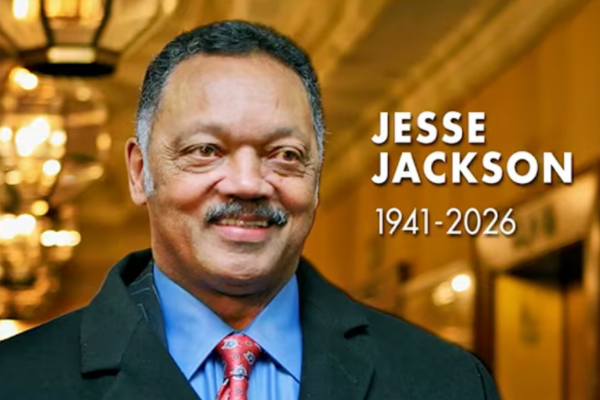
Rev. Jesse Jackson, the influential civil rights leader, political activist, and two-time Democratic presidential candidate, has died at the age of 84. According to family members, he passed away peacefully on February 17, 2026, surrounded by his family, they said in a statement.
Jackson was hospitalized for observation in November, and doctors said he’d been diagnosed with a degenerative condition called progressive supranuclear palsy. He revealed in 2017 that he had been diagnosed with Parkinson’s disease, which affects the nervous system and slowly restricts movement and daily activities. Jackson called it a “physical challenge,” but he refused to let it prevent him from continuing his civil rights advocacy. His father, Noah Lewis Robinson Sr., also had Parkinson’s and died of the disease in 1997 at the age of 88.
Born October 8, 1941, in Greenville, South Carolina, to 16-year-old Helen Burns Struggs, he was originally named Jesse Burns. He later took the surname Jackson after his mother married Charles Jackson. Growing up under Jim Crow laws, Jackson was an honors student in high school and earned a football scholarship to the University of Illinois before transferring to North Carolina A&T, graduating in 1964.
Jackson’s “unwavering commitment to justice, equality, and human rights helped shape a global movement for freedom and dignity. A tireless change agent, he elevated the voices of the voiceless … leaving an indelible mark on history,” his family said.

“Our father was a servant leader — not only to our family, but to the oppressed, the voiceless, and the overlooked around the world,” the family said. “We shared him with the world, and in return, the world became part of our extended family. His unwavering belief in justice, equality, and love uplifted millions, and we ask you to honor his memory by continuing the fight for the values he lived by.”
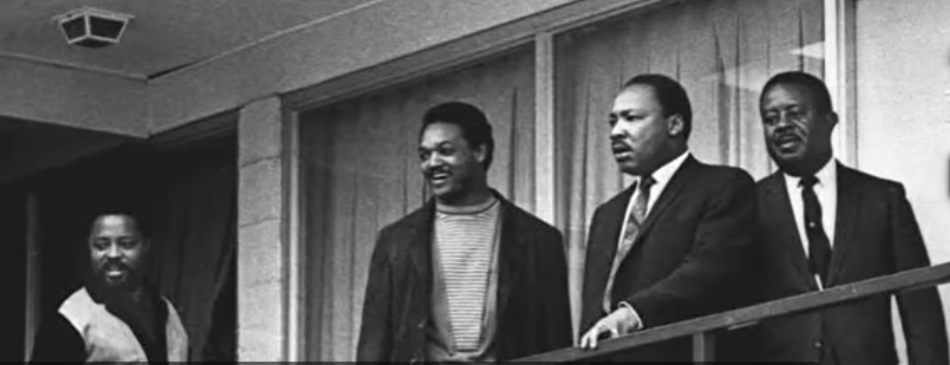
Jackson first gained national prominence in the 1960s as a close associate of Dr. Martin Luther King Jr. He played a key role in major civil rights campaigns, including Operation Breadbasket, which focused on economic empowerment for Black communities. In a well-known photograph taken at the Lorraine Motel in Memphis, Jesse Jackson stands beside Martin Luther King Jr., Hosea Williams, and Ralph Abernathy just one day before King was assassinated on that same balcony.
Following King’s assassination in 1968, Jackson continued the fight for racial and economic justice, eventually founding Operation PUSH (People United to Save Humanity), which later evolved into the Rainbow/PUSH Coalition. Through these organizations, he championed voter registration, education access, corporate accountability, and equal opportunity.
October 8, 1941

In 1984 and 1988, Jackson made historic runs for the Democratic presidential nomination, building multiracial coalitions and expanding political participation among African Americans and other marginalized groups. His 1988 campaign, in particular, marked a significant milestone, winning several primaries and influencing the national political conversation.
Over decades, Jackson remained a persistent advocate for civil rights, social justice, and international humanitarian causes. His leadership, oratory skill, and unwavering commitment to equality left an indelible mark on American public life, securing his place as one of the most consequential civil rights figures of the modern era.
Arrangements, according to a source, are being handled by Leak & Sons Funeral Homes, a historic, Black-owned institution in Chicago operating since 1933, has deep ties to civil rights history, having provided services for figures like Sam Cooke and supported Dr. Martin Luther King Jr..