

The University of South Florida (USF) has revealed its most comprehensive vision yet for transforming the site of its closed Claw golf course into a vibrant, mixed-use community known as the Fletcher District. The proposal was presented by USF Chief Financial Officer Jennifer Condon during the Board of Trustees meeting, signaling a major shift toward expanding housing, retail, and green space on the underutilized land.
Spanning 27 acres of the 120-acre site, the first phase envisions a dynamic, pedestrian-friendly neighborhood. It will feature two student housing buildings—totaling 335,000 square feet—along North 46th Street. Additional multi-family housing units, approximately 150 in total, will be designed for graduate students, faculty, and staff. The concept also includes an academic research building, retail shops, restaurants, and generous public green space, laying the groundwork for both community connection and campus integration.
If approved by the Board of Trustees on September 9—and later by the Florida Board of Governors on November 6—USF plans to begin construction as early as spring 2026. The first phase is anticipated to open by summer 2028, only a year after completion of the university’s new on-campus stadium.
Board of Trustees member and Faculty Senate President David Simmons noted the potential for profound impact: “I think this is really going to transform the experience for a lot of our students, faculty, and staff,” he remarked, pointing to the convenience and vitality such a development could bring.
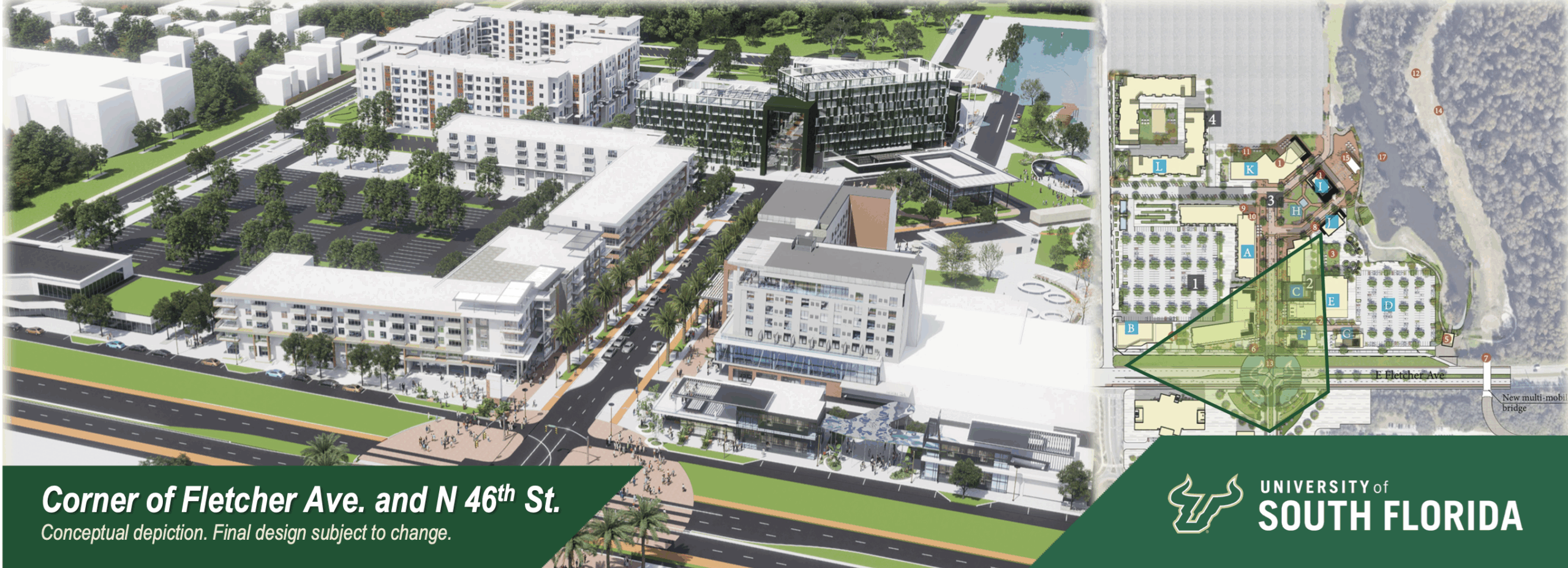
The shift follows USF’s strategic decision to halt previous plans to replace aging dormitories—a move that faces increasing demand for student housing amid a 35% surge in applications. With the Claw golf course vacated in September 2023, the university redirected focus to this more community-oriented redevelopment effort.
This initiative aligns with broader trends in urban planning within the Tampa Bay area, where new multi-use districts are becoming key drivers of economic growth and campus life. USF’s phased approach balances university needs with sustainable, integrated design.
If the proposal receives final approval, USF’s Fletcher District would mark a major evolution in campus development—creating a tight-knit, engaged hub for living, learning, and life.
Across the United States, more than 1,500 golf courses have closed since 2014, creating new opportunities for redevelopment. During the golf boom between 1986 and 2006, over 4,000 courses were built, but many have since become unsustainable due to declining participation and rising maintenance costs. In areas such as South Florida, dozens of courses have been converted in recent years, with Palm Beach County alone seeing more than a dozen transformed into residential communities and mixed-use spaces. While housing remains the most common redevelopment path, many properties are being reimagined as parks, community centers, retail districts, and mixed-use developments that combine housing, shopping, and recreational amenities.
Developers are also increasingly incorporating commercial facilities such as medical offices, event venues, and hospitality spaces into these projects, creating more diverse and sustainable uses for the land. The trend reflects changing demographics in the sport, as interest among younger players has declined sharply, while urban and suburban communities face growing demand for housing and multi-use amenities. In regions with limited land availability, former fairways and clubhouses are proving especially valuable as they can be repurposed into vibrant, multi-functional neighborhoods.
The economic impact of these conversions has been significant, with many projects revitalizing communities and creating new tax bases. Former golf courses are now becoming hubs of activity where people live, work, and gather, rather than exclusive green spaces reserved for a shrinking group of players. This transformation shows no sign of slowing down, as both developers and municipalities recognize the opportunity to turn underutilized land into thriving destinations that better reflect the needs of today’s communities.