Source: WalletHub



[See more daily coverage: April 5 | April 6 | April 7 | April 8 ]
(April 8, 2018) I’ve arrived at the Media Center at 5:50 AM on Sunday. Looking around, I discover that the African American Golfers Digest is the first one here. So, I had the place all to myself for 12 whole minutes, that is until the media folks from the Tokyo Sports Press and Golf Digest Japan came in and went right to work—remember it’s 6:50 PM in Japan (UTC +9 time zone).
BY THE WAY
On this day in 1974, Hank Aaron broke Babe Ruth’s career record by hitting his 715th home run off LA pitcher Al Downing (also an African American).
On this day in 1975, Frank Robinson became the first black manager in major league history by making his debut as player-manager of the Cleveland Indians.
These accomplishments serve as testimony to the fact that when given the opportunity, we can, and will, excel!!
Back to Golf:
Well, in my relative 12 minutes of morning solitude in the Media Center, I was reading the Sunday Augusta Chronicle and saw this article which I wanted to share with AAGD readers. Please read on.
“Famous Augusta National caddie no longer has unmarked grave”
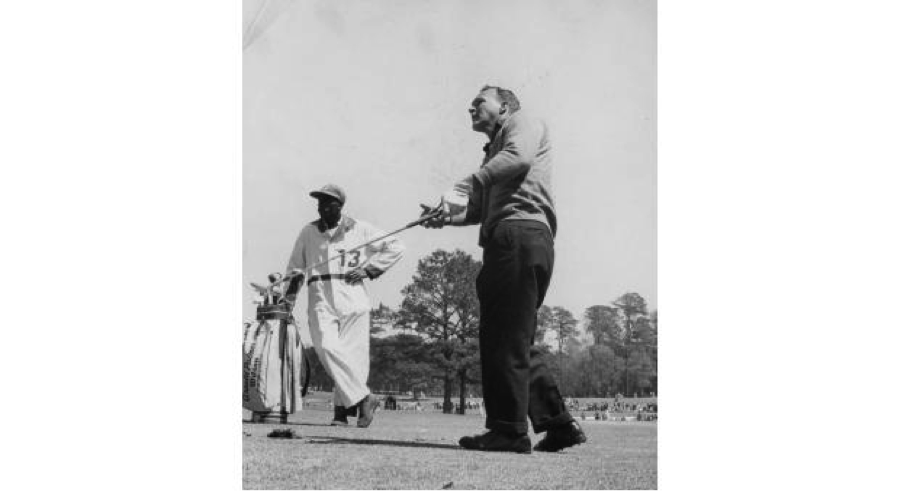
Nathaniel “Iron Man” Avery caddying for Arnold Palmer. (Augusta Chronicle)
Avery, an Augusta native, died in 1985 and was buried at a cemetery about five miles from Augusta National. Nathaniel “Iron Man” Avery first caddied for Arnold Palmer at Augusta National in 1955 and was on the bag for all of his Masters victories.
Nathaniel “Iron Man” Avery
One of the most famous caddies in Masters Tournament history finally has a marker on his Augusta grave. Nathaniel “Iron Man” Avery, who caddied for Arnold Palmer in all four of his Masters victories, had been laid to rest in an unmarked grave in Southview Cemetery when he died in 1985.
Former Augusta resident Ward Clayton, an executive producer on the documentary “Loopers: A Caddie’s Life,” which will be released this summer, has known for years there was no gravestone for Avery at the all-black cemetery. But last summer, he wanted to make sure. He found the number of the plot where Avery was located. There was still no gravestone.
An anonymous donor, in conjunction with the documentary, helped to change that. They designed and picked up the expense for the cost of the gravestone. It was unveiled last summer at the cemetery, about five miles from Augusta National Golf Club’s gates.
Former Westside High School and Duke guard and NBA first-round pick Will Avery, who is a great nephew to Iron Man, was among the family members at the cemetery the day the gravestone was placed.
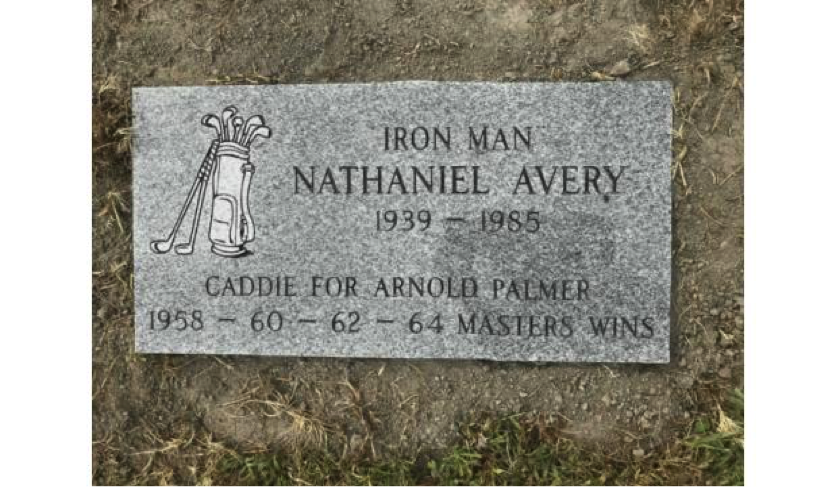
Gravestone of Nathaniel “Iron Man” Avery (Augusta Chronicle)
“It meant a lot to me,” said Avery, who is now 38 and lives in Augusta. “I wasn’t even aware (of the unmarked grave) until this came about. I’m glad he got his just due. My family is thankful and proud he has that.” Will Avery was born after Iron Man died, but he heard all the stories of the man who he has always called his Uncle Iron Man. “His success, in today’s world, would be celebrated much more,” Avery said, referring to his four wins at the Masters. “That’s an amazing accomplishment.”
The record for most Masters wins by an Augusta National caddie is five each, by Willie “Pappy” Stokes and Willie Peterson, while Avery and Steve Williams have four each. The film traces the history of caddies and “a huge part” of it details Augusta National caddies such as Iron Man, according to Clayton.
Avery was one of the first caddies to become publicly known because he was by Palmer’s side as the King took the golf world by storm. Palmer was assigned Avery as his Masters caddie starting with his Augusta National debut in 1955, when he tied for 10th place.
Palmer then won green jackets in 1958, 1960, 1962 and 1964, making this the 60th anniversary of Palmer’s first victory. Avery caddied for Palmer through “the late ’60s,” said Clayton, whose 2004 book “Men on the Bag” was about Augusta National caddies. In his book, Clayton writes that Avery would buy a new car the day after each Masters victory. Avery fell on hard times after losing connection with Palmer. Arnold Palmer won the Masters in 1958,1960,1962 and 1964
LEE AND SHARON ELDER ENJOYING THE MASTERS
I took a break from the media building and went touring the course and bumped into Lee Elder and his wife, Sharon. We all know what Mr. Elder had to endure when he broke the color line at Augusta National in 1975. In my mind he will forever be royalty at Augusta.
By the way, lunch today was pineapple chicken and collard green soup. Need I say more?
Tiger actually did better than I predicted and shot a 3 under par 69 which gets him into a tie for 32nd place, good for just about $68,000. While I am mildly disappointed that he did not win, I am encouraged by his gritty performance each of the four days as there were many points at which his performance could have gone very sour. I think he should take pride in battling to make the cut and going under par in his final round.
He undoubtedly will work on his irons to ensure himself better looks for birdie pouts. Overall, I am encouraged and expect continued improved performance this season, including a win.
I will tell you that the media center is as loud as it has been all week watching Jordan Spieth and Patrick Reed go at it with a good mixture of Ricky Fowler added to the mix.
Eventually, Patrick Reed won the 2018 Masters. His grit and determination were on display, especially after he bogeyed the first hole. He gathered himself and played steady golf shooting a 1 under 71. I was very impressed with Jordan Spieth who fired an 8 under 64 and would have tied the course record had he not bogeyed 18. What a day!
I have made many new friends and acquaintances this week at the Masters, as this serves as testimony that golf brings people together from all backgrounds and geography. We all want to see great shots, head-to-head play, overcoming adversity, long putts made and low scores.
This has been a great week for me and another one starts tomorrow, as I head to the 24th annual National Women’s Collegiate Golf Championship sponsored by the Women in Golf Foundation which will be held at the Whitewater Creek Country Club in Fayetteville, GA.
 RELATED ARTICLE:
Women in Golf Foundation Past Champions
The participating schools will compete for the Renee Powell Cup honoring Renee Powell, the second African American to compete on the LPGA as a female professional golfer. The event is officiated by Georgia Golf Association, PGA professionals and USGA volunteers.
I appreciate each and everyone one of you who read my daily reports. I hope I was able to share my experiences to your satisfaction. If you find yourself Augusta during Masters week next year, you should stop in and enjoy the place. The Augusta National Golf Club is a sight to behold.
It really is “all that and a bag of chips”…theirs.
I would be very honored if you would send me your comments, suggestions and ideas.
Thanks for reading. Meet me at the Masters next year.
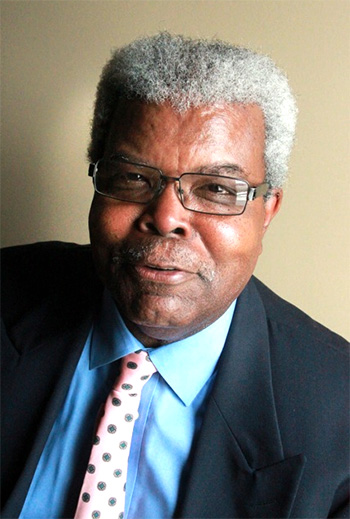 James R. Beatty is Founder of NCS International, an Omaha, Nebraska-based company that providers of an array of economic development services. He serves as Executive Editor at the African American Golfer’s Digest and on the Golf 20/20 Diversity Task Force.

By James Beatty
[See more daily coverage: April 5 | April 6 | April 7 | April 8 ]
(April 7, 2018) Well, Tiger made the cut and I was looking forward to him making a move on Saturday. He did shoot par with 3 bogeys and 3 birdies. I saw one of those birdies on the par 5 Hole number 8 where he chipped up and sank a putt. According to Tiger “ I am not playing the par 5’s well…I have not gotten it done with my irons, I am missing in the wrong spots…My goal for Sunday is to get to even par or below for the tournament.”
The way Patrick Reed played today makes it virtually impossible that Tiger could catch him since he is leading at 14 under. However, if Tiger could go 6 under tomorrow he could end up in red figures and have a top 20 finish. I think it is more likely that he shoots 70 or 71 based on the previous stats. (See Chart below) This would get him to 2 over for the tournament and likely a top 30 finish.
| Thursday | Friday | Saturday | |
| Greens in Regulation | 11 of 18 | 10 of 18 | 12 of 18 |
| Fairways Hit | 8 of 14 | 7 of 14 | 4 of 14 |
| Driving
Distance |
290.9 | 303.2 | 294.5 |
| Number of
Putts |
28
|
28 | 29 |
| Score | 73 | 75 | 72 |
With a 30th place solo finish, he will earn $74,800
Here is the money payout by place for the Masters.
Seeing this, one can clearly understand the difference a stroke can make. Betcha By Golly Wow!


Masters-branded canvas folding chair
While on the course today, I was also able to meet a couple of folks from the Augusta area. I met Wade Sumpter, 56, and Anthony Holland, 55.
I noticed these gentlemen while I was walking around Hole 18 greens. They were checking on their Masters chairs, which they placed in the designated sitting area around the 18th green a few hours earlier.
Yes, the Masters even have their own chairs!
It is very common, and a long-standing tradition, that people come out early and place their chair in their preferred sitting /viewing area and then leave to see other parts of the course. When they return, they simply go to their chairs to enjoy the play at the hole—which is an outstanding testament to the respectfulness of golf fans at Augusta National. There are literally hundreds (if not thousands) of these chairs placed all around the course in this time-tested tradition.
What other sporting event lets you choose your seat?
The Masters even lets you bring the seat. By 8 o’clock this morning, thousands of green Masters-branded canvas folding chairs ($30 retail price) had been set up around Augusta National Golf Club. Here’s the drill: gates open when the light’s good (about 7:15 am or so) and folks stake their claim to a piece of ground.
It’s astonishing. First, there’s not a chair in sight; if left in place overnight, they’ll be removed by clean-up crews. But an hour after the gates open, they’re everywhere — that is, everywhere marked “Sitting Area.” Men, women, and children hurry to their favored spots where they pop open the chairs and plop them down. Then they go walking off in confidence that when the time comes, they’ll have a terrific place to watch all the drama.
“People don’t mind if you use their chairs when they’re not there,” a security man said to me, “as long as you leave when they return. We don’t have much problem with that. Most of these people have been here long enough they know how to behave.”
Read more on this at Source: https://www.golfdigest.com/story/at-the-masters-a-good-seat-is-worth-the-wait
I may be nieve, but in my 14 trips to the Masters, this is the first time that I have ever seen brothers—black men— doing this. I am sure it has been done before but I was simultaneously amazed and intrigued, so I had to talk to them.
Wade and Anthony are retired Military and are avid golfers, Wade has a handicap of 14 and Anthony simply said that his is higher.
There were following a few players including Patrick Reed, Justin Thomas, Marc Leishman and Rory McIlroy. Wade and Anthony just wanted to see good golf and took the extra step of claiming their spot on the course, to do so, as they have been doing for the past 12 years. Way to go, brothers!
So when you come to Augusta, you can bring your own chair. Lesson Learned. I think I will do this at my next outdoor concert. I’ll let you know how that goes.
As a follow-up to my reference to the variety of Masters snack foods available, I’ve added a few others that you might enjoy as well.
IT’S LUNCHTIME AT THE MASTERS!
Peanuts, Trail Mix, Popcorn and Cookies make up the variety of snacks available with the Masters brand.
I will also tell you that the hot meals they serve to the media would more than rival the finest of 5-star restaurants, anywhere!
The shrimp etouffee and gumbo that I enjoyed today were to die for! Well, tomorrow (Sunday) is the grand finale and according to all historians of the Masters, the tournament will be won, or lost, on the back nine holes tomorrow.

by Jim Beatty
[See more daily coverage: April 5 | April 6 | April 7 | April 8 ]
At the average ticket price of $2,100 for Sunday’s round, this steep cost for attending the final day of competition at the Masters in Augusta, Georgia, is no barrier for avid golf fans. Attendees come from around the country— and around the world—to make their way to the pristine greens of Augusta National. What they aim to see is exactly who will split this year’s $1.98 million purse.
Below are just a few of the glorious moments that I shared with folks who were there!

Tiger coming up Number 9 on Wednesday Practice Round

Friends from Houston

Friends from Houston in front of the leaderboard
Members of the Pro Duffers from Washington, DC

Gwen Jones, Retired Executive from Midlothian, Texas

Avid golfers from Richmond, VA, and the North Carolina area

Ty and Rod Brown from Aventura, Florida

International golfers from Johannesburg, South Africa
[See more daily coverage: April 5 | April 6 | April 7 | April 8 ]
(April 6, 2018) —Ok, so today I was concerned about Tiger making the cut given his errant shots. Like everyone else, I held my breath with each shot. I was happy, elated disappointed, breathless and exhausted watching him but I was hanging with him!! Nervously, munching on Masters snacks.
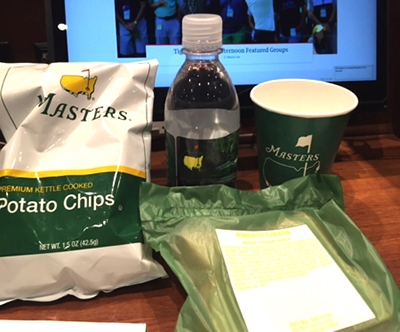
Yes, the Masters has their own potato chips, water, famous moon pies and even the napkins and cups to match. These and other more nutritious delights are readily available in the state-of-the-art new Media Building, which is where I am housed for the week of the Masters along with hundreds of other media personnel from all over the world.
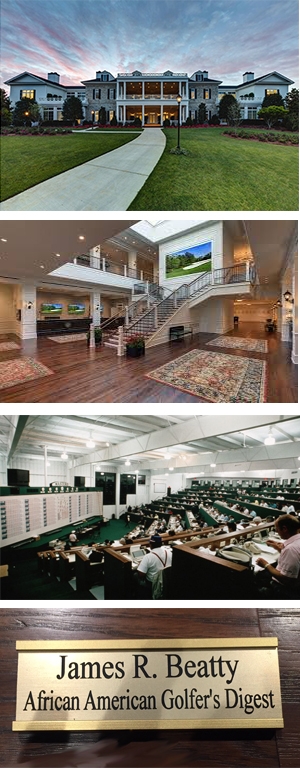 The new media center is conducive to writing and filing my daily reports for AAGD and the facility spared no expense in making certain all of the amenities were in place. The two-story building is located at the west end of the tournament practice range. The exterior has all the trimming of a stately mansion that graced many Southern plantations back in the day, including a stone façade, tall white columns and covered porches.
On the first floor is the Media check-in spot. Reporters can then make their way upstairs to the second floor to the working press room. Each media desk in the press room is hard-wired, equipped with high-speed Internet and its own TV monitor and scoring computer.
During the week, players meet with media in the interview room where reporters have individual desks with customized nameplates and microphones for asking their questions to players.
The center also has a formal dining area that serves breakfast and lunch for attending media and there is an outdoor eating area and a lounge for the tired and worn-out journalists to relax during their hard days of work
—Makes you envy me for covering the Masters, am I right?
At this point, I just want Tiger to make the cut in this field of 87 players. Winning can come later. The cut will be determined in the following manner.
After 36 holes of play, a cut-off score is calculated to reduce the size of the field for the weekend rounds. To “make the cut”, players must be either in the top 50 places (ties counting) or within 10 strokes of the leader’s score.
So Patrick Reed, who played collegiately at Augusta State College, was on fire today shooting a 6 under 66 and leads the field with 9 under for the tournament. Tiger shot a 75, 3 over for the day and 4 over for the tournament and made the cut by 1 stroke with a score of 148, which ties him for 40th place, 14 strokes behind.
For the record, Tiger’s statistics on Friday were:
• 10 of 18 Greens in Regulation – 55.6%
• 7 o 14 Fairways Hit – 50%
• 303.2 Yards – Driving Distance
(His longest drive was 339.9 Yards on Hole 15)
• 1.90 Average Putts for Greens in Regulation
Time for more snacks!
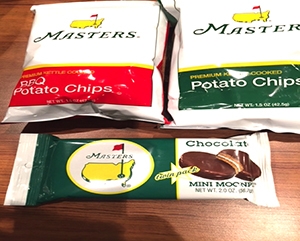
…more snacks at the MASTERS
Also on the course today I had the pleasure of meeting 3 young ladies from the area:
Raven Washington, a 5th grader for Augusta, Georgia who is planning to go to college at Kennesaw State. Hanna Evans, an 8th grader also from Augusta and she is planning to go to college at Georgia State. She also has been involved with the First Tee of Augusta.
Noria Williams, a 9th grader from Aiken, South Carolina. Noria is planning to go to Clafin University. Noria’s mother, Teresa Williams, accompanied the young ladies.
The young ladies were attending the golf tournament as part of the National Society of Black Engineers Junior program, which encourages Black youth to pursue studies in the engineering fields and to properly prepare for college.
I took the opportunity talk quite a bit about the role of technology and engineering in golf, ranging from the golf course design and maintenance to the clubs and accessories that are used by the players.
This is a great example of how local and national organizations can partner and encourage our youth academically as well as introducing them to the great game of GOLF.

Charlton Carswell
I should also mention that the AAGD magazine picked up a new reader this morning! As I was waiting to buy some supplies at Staples. Mr. Charlton Carswell, who lives in the Augusta area, (pictured) was clearly fascinated with the magazine! AAGD Publisher, Debert cook even called and thanked him for his interest. This is the personal touch of AAGD!! We take the time to listen and talk with folks. To us, everyone is important to growing this game. Welcome! Mr. Carswell to our AAGD family.
Stay tuned for more to come from the 2018 Masters.
James Beatty, Executive Editor, African American Golfer’s Digest James R. Beatty is Founder of NCS International, an Omaha, Nebraska-based company that providers of an array of economic development services. He serves as Executive Editor at the African American Golfer’s Digest and on the Golf 20/20 Diversity Task Force.

[See AAGD daily coverage: April 5 | April 6 | April 7 | April 8 ]
10:10 a.m.: Matthew Fitzpatrick, Kiradech Aphibarnrat
10:20 a.m.: Tyrrell Hatton, Phil Mickelson
10:30 a.m.: Webb Simpson, Xander Schauffele
10:40 a.m.: Tiger Woods, Ian Poulter
10:50 a.m.: Adam Scott, Bryson DeChambeau
11 a.m.: Doug Ghim, Bernhard Langer
11:10 a.m.: Martin Kaymer, Si Woo Kim
11:20 a.m.: Brian Harman, Daniel Berger
11:30 a.m.: Chez Reavie, Kevin Ksiner
11:40 a.m.: Branden Grace, Jason Day
11:50 a.m.: Francesco Molinari, Kyle Stanley
12 p.m.: Ryan Moore, Jhonattan Vegas
12:10 p.m.: Satoshi Kodaira, Fred Couples
12:30 p.m.: Rafael Cabrera Bello, Vijay Singh
12:40 p.m.: Haotong Li, Russell Henley
12:50 p.m.: Tommy Fleetwood, Adam Hadwin
1 p.m.: Hideki Matsuyama, Zach Johnson
1:10 p.m.: Bernd Wiesberger, Jimmy Walker
1:20 p.m.: Matt Kuchar, Jon Rahm
1:30 p.m.: Charley Hoffman, Cameron Smith
1:40 p.m.: Justin Rose, Bubba Watson
1:50 p.m.: Rickie Fowler, Louis Oosthuizen
2 p.m.: Justin Thomas, Tony Finau
2:10 p.m.: Jordan Spieth, Dustin Johnson
2:20 p.m.: Henrik Stenson, Rory McIlroy
2:30 p.m.: Patrick Reed, Marc Leishman

Starting Things Off
[See more daily coverage: April 5 | April 6 | April 7 | April 8 ]
L-R: Chris Malloy and Jim Beatty-2018 Masters
On Wednesday and Thursday, I conducted several on-course interviews with various spectators. Whenever I saw a group of ‘us’ (Black folks), I wandered over and started a conversation.
I talked with Ron Albrechton and Corey Anderson from Macon, Georgia and a group of gentlemen from, Johannesburg South Africa, Oren Mayers (a 1 handicapper from Ghana), John Hayes (Cincinnati, Ohio), David Walker (Richmond, Virginia), Ty and Rod Brown (Aventura, Florida).
Also on the scene was Willie Eigner and Gary Walden (Seattle, Washington), Gwen Jones (a retired accountant from Midlothian, Texas), Chris Malloy and David Walker (Houston, TX). And to my delight, several members of the Pro Duffers Golf Club from Washington DC.
I wanted to know:
Here is what they told me.
Why They Came:
How the Got their Ticket:
What Impressed them about the Augusta National Golf Course:
Who are they pulling for:
Well, these are all reasons why anyone reading this should come to Augusta, Georgia and enjoy the MASTERS. It is a great golf experience and one that will be remembered for a lifetime.
TAKING IT ALL IN WITH SOME GREAT FOLKS

L-R: David Walker and Jim Beatty
These folks and many other African American golf fans who love and play the sport know and understand the significance and historical importance of Augusta National. These good people represent the great cross-section of the 80,000 readers of AAGD (African American Golfer’s Digest) and, are the reasons why companies want to connect with our well-informed audience.
Well, I also spent time on the course watching the players—of course—and from many vantage points. In some cases, I wanted to see their tee shot, so, I stood behind the tee box and watched carefully as their ball striking seemed so effortless and smooth.
Sometimes I stood at the landing area of their tee shot, so I could watch them discuss and diagnose the approach shots. Other times I watched them putt, which at Augusta National is like trying to putt on glass while roller-skating. There are no straight putts with the possible exception of a tap-in, which are few and far between.
 RELATED ARTICLE: 50-1 Odds for Tiger Woods to Win the Masters in April 2018
Yes, I did watch Tiger Woods but you needed to secure your vantage point at least 2 holes ahead of where he is playing, as the crowds follow him in great numbers. Like many people, I have been very encouraged by his recent play and what appears to be a pain-free effort. Some have even predicted him to win. At the Thursday news interview with Jack Nicklaus and Gary Player, they both thought Tiger could be in contention. Not a bad endorsement from two fellas who, combined, have won this tournament 9 times. So if you are pulling for Tiger to win, you are in for a ride of emotions this week, for the following statistical reasons: Tiger was:
But the most important statistic is that Tiger impressively bogeyed the Par 3 hole number 12. His tee shot hit the bank and rolled into the water so, he had to take a drop and chip up. This left him for a long putt, which he drained. Otherwise, it was a double bogey— or worse— waiting to really mess up his scorecard. In my humble opinion, his bogey save was the difference between a competitive day versus a disaster. Ask Sergio Garcia, the defending champion, who took a 13 or the Par 5, Hole 15. Golf can be so cruel. So, Mr. Woods averted a disaster and actually birdied two of the final 5 holes to end his day at a one over par 73, So after round one, Tiger is tied for 29th. 7 shots behind the leader, Jordan Speith at 6 under. Friday’s round will provide the opportunity for Tiger to improve and we all know that Spieth can go low. So Tiger and others, time to step it up.
Thanks for letting me share my last 2 days with you at Augusta National! More to come….
James Beatty, Executive Editor, African American Golfer’s Digest James R. Beatty is Founder of NCS International, an Omaha, Nebraska-based company that providers of an array of economic development services. He serves as Executive Editor at the African American Golfer’s Digest and on the Golf 20/20 Diversity Task Force.
by James R. Beatty
[See more daily coverage: April 5 | April 6 | April 7 | April 8 ]
It is April 4, 2018 and I am overjoyed to be seated in the magnificent Media room at the Masters in Augusta, Georgia but I must remember the significance of this date and pay homage to how I and others of color were able to gain access to this golfing venue and other golf courses across the nation. Yes, it was 50 years ago today that Martin Luther King Jr. was struck down and killed by the assassin’s bullet in Memphis TN.
It would be a 7 years later to the date that Lee Elder would become the first African American to play in the famed Augusta Invitational. It is also interesting to note that Lee Elder received hate mail and death threats when he played in the Masters. It would also be 7 years and 8 months later that Eldrick “Tiger” Woods would be born. So the significance on my being here is not lost as today the nation commemorates the MLK assassination which was born of hate and racism while simultaneously waiting to coronate a new champion, who will be loved by all in Augusta for sure.
 RELATED ARTICLE: Lee Elder’s Next Big Hurdle in Golf: The World Golf Hall of Fame
Thank you, Martin, for your ultimate sacrifice, I am not in this chair without you. Thank you, Lee, for your grace and courage under fire. Thank you, Tiger, for what you have done and what many of us hope you will do this week. Golf and America still have a way to go.
Stay tuned for more from the Masters!
James R. Beatty is Founder of NCS International, an Omaha, Nebraska-based company that providers of an array of economic development services. He serves as Executive Editor at the African American Golfer’s Digest and on the Golf 20/20 Diversity Task Force.
by AAGD STAFF
On this anniversary day, it’s been 50-years since the brutal assassination of the Rev. Martin Luther King Jr. His legacy is etched in time forever and his work is still the topic of many conversations. Today, millions adore him and his process to help Blacks in America reach the “mountaintop” — a final plateau of racial and economic harmony. However, in 2018, the struggle continues. Today, The King Center tweeted: “We remember. We rise. We resist injustice, apathy, inhumanity.”
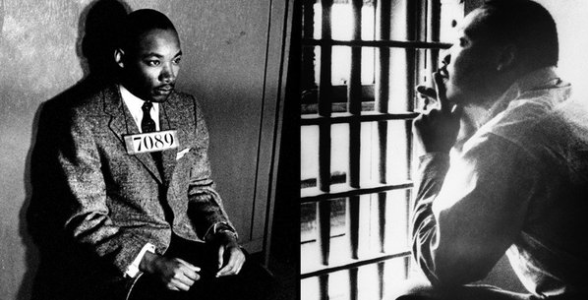
Below is the letter that was written by Dr. King during his incarceration in a Birmingham, Alabama jail. Read it to compare just how far have we have come— and how far we have yet to go as a race of Black people in America.
LETTER FROM THE BIRMINGHAM JAIL (MLK, JR.)
16 April 1963
My Dear Fellow Clergymen:
While confined here in the Birmingham city jail, I came across your recent statement calling my present activities “unwise and untimely.” Seldom do I pause to answer criticism of my work and ideas. If I sought to answer all the criticisms that cross my desk, my secretaries would have little time for anything other than such correspondence in the course of the day, and I would have no time for constructive work. But since I feel that you are men of genuine good will and that your criticisms are sincerely set forth, I want to try to answer your statement in what I hope will be patient and reasonable terms.
 RELATED ARTICLE: Grow The Game Fund Petition Asks For Monetary Support of Diversity & Inclusion in Golf
I think I should indicate why I am here in Birmingham, since you have been influenced by the view which argues against “outsiders coming in.” I have the honor of serving as president of the Southern Christian Leadership Conference, an organization operating in every southern state, with headquarters in Atlanta, Georgia. We have some eighty five affiliated organizations across the South, and one of them is the Alabama Christian Movement for Human Rights. Frequently we share staff, educational and financial resources with our affiliates. Several months ago the affiliate here in Birmingham asked us to be on call to engage in a nonviolent direct action program if such were deemed necessary. We readily consented, and when the hour came we lived up to our promise. So I, along with several members of my staff, am here because I was invited here. I am here because I have organizational ties here.
But more basically, I am in Birmingham because injustice is here. Just as the prophets of the eighth century B.C. left their villages and carried their “thus saith the Lord” far beyond the boundaries of their home towns, and just as the Apostle Paul left his village of Tarsus and carried the gospel of Jesus Christ to the far corners of the Greco Roman world, so am I compelled to carry the gospel of freedom beyond my own home town. Like Paul, I must constantly respond to the Macedonian call for aid.
Moreover, I am cognizant of the interrelatedness of all communities and states. I cannot sit idly by in Atlanta and not be concerned about what happens in Birmingham. Injustice anywhere is a threat to justice everywhere. We are caught in an inescapable network of mutuality, tied in a single garment of destiny. Whatever affects one directly, affects all indirectly. Never again can we afford to live with the narrow, provincial “outside agitator” idea. Anyone who lives inside the United States can never be considered an outsider anywhere within its bounds.
 RELATED ARTICLE: TURNING HIS BACK TO THE USGA: Open Letter To The USGA Regarding Trump And His Affiliation.
You deplore the demonstrations taking place in Birmingham. But your statement, I am sorry to say, fails to express a similar concern for the conditions that brought about the demonstrations. I am sure that none of you would want to rest content with the superficial kind of social analysis that deals merely with effects and does not grapple with underlying causes. It is unfortunate that demonstrations are taking place in Birmingham, but it is even more unfortunate that the city’s white power structure left the Negro community with no alternative.
In any nonviolent campaign there are four basic steps: collection of the facts to determine whether injustices exist; negotiation; self purification; and direct action. We have gone through all these steps in Birmingham. There can be no gainsaying the fact that racial injustice engulfs this community. Birmingham is probably the most thoroughly segregated city in the United States. Its ugly record of brutality is widely known. Negroes have experienced grossly unjust treatment in the courts. There have been more unsolved bombings of Negro homes and churches in Birmingham than in any other city in the nation. These are the hard, brutal facts of the case. On the basis of these conditions, Negro leaders sought to negotiate with the city fathers. But the latter consistently refused to engage in good faith negotiation.
Then, last September, came the opportunity to talk with leaders of Birmingham’s economic community. In the course of the negotiations, certain promises were made by the merchants–for example, to remove the stores’ humiliating racial signs. On the basis of these promises, the Reverend Fred Shuttlesworth and the leaders of the Alabama Christian Movement for Human Rights agreed to a moratorium on all demonstrations. As the weeks and months went by, we realized that we were the victims of a broken promise. A few signs, briefly removed, returned; the others remained. As in so many past experiences, our hopes had been blasted, and the shadow of deep disappointment settled upon us. We had no alternative except to prepare for direct action, whereby we would present our very bodies as a means of laying our case before the conscience of the local and the national community. Mindful of the difficulties involved, we decided to undertake a process of self purification. We began a series of workshops on nonviolence, and we repeatedly asked ourselves: “Are you able to accept blows without retaliating?” “Are you able to endure the ordeal of jail?” We decided to schedule our direct action program for the Easter season, realizing that except for Christmas, this is the main shopping period of the year. Knowing that a strong economic-withdrawal program would be the by product of direct action, we felt that this would be the best time to bring pressure to bear on the merchants for the needed change.
Then it occurred to us that Birmingham’s mayoral election was coming up in March, and we speedily decided to postpone action until after election day. When we discovered that the Commissioner of Public Safety, Eugene “Bull” Connor, had piled up enough votes to be in the run off, we decided again to postpone action until the day after the run off so that the demonstrations could not be used to cloud the issues. Like many others, we waited to see Mr. Connor defeated, and to this end we endured postponement after postponement. Having aided in this community need, we felt that our direct action program could be delayed no longer.
You may well ask: “Why direct action? Why sit ins, marches and so forth? Isn’t negotiation a better path?” You are quite right in calling for negotiation. Indeed, this is the very purpose of direct action. Nonviolent direct action seeks to create such a crisis and foster such a tension that a community which has constantly refused to negotiate is forced to confront the issue. It seeks so to dramatize the issue that it can no longer be ignored. My citing the creation of tension as part of the work of the nonviolent resister may sound rather shocking. But I must confess that I am not afraid of the word “tension.” I have earnestly opposed violent tension, but there is a type of constructive, nonviolent tension which is necessary for growth. Just as Socrates felt that it was necessary to create a tension in the mind so that individuals could rise from the bondage of myths and half truths to the unfettered realm of creative analysis and objective appraisal, so must we see the need for nonviolent gadflies to create the kind of tension in society that will help men rise from the dark depths of prejudice and racism to the majestic heights of understanding and brotherhood. The purpose of our direct action program is to create a situation so crisis packed that it will inevitably open the door to negotiation. I therefore concur with you in your call for negotiation. Too long has our beloved Southland been bogged down in a tragic effort to live in monologue rather than dialogue.
One of the basic points in your statement is that the action that I and my associates have taken in Birmingham is untimely. Some have asked: “Why didn’t you give the new city administration time to act?” The only answer that I can give to this query is that the new Birmingham administration must be prodded about as much as the outgoing one, before it will act. We are sadly mistaken if we feel that the election of Albert Boutwell as mayor will bring the millennium to Birmingham. While Mr. Boutwell is a much more gentle person than Mr. Connor, they are both segregationists, dedicated to maintenance of the status quo. I have hope that Mr. Boutwell will be reasonable enough to see the futility of massive resistance to desegregation. But he will not see this without pressure from devotees of civil rights. My friends, I must say to you that we have not made a single gain in civil rights without determined legal and nonviolent pressure. Lamentably, it is an historical fact that privileged groups seldom give up their privileges voluntarily. Individuals may see the moral light and voluntarily give up their unjust posture; but, as Reinhold Niebuhr has reminded us, groups tend to be more immoral than individuals.
We know through painful experience that freedom is never voluntarily given by the oppressor; it must be demanded by the oppressed. Frankly, I have yet to engage in a direct action campaign that was “well timed” in the view of those who have not suffered unduly from the disease of segregation. For years now I have heard the word “Wait!” It rings in the ear of every Negro with piercing familiarity. This “Wait” has almost always meant “Never.” We must come to see, with one of our distinguished jurists, that “justice too long delayed is justice denied.”
We have waited for more than 340 years for our constitutional and God given rights. The nations of Asia and Africa are moving with jetlike speed toward gaining political independence, but we still creep at horse and buggy pace toward gaining a cup of coffee at a lunch counter. Perhaps it is easy for those who have never felt the stinging darts of segregation to say, “Wait.” But when you have seen vicious mobs lynch your mothers and fathers at will and drown your sisters and brothers at whim; when you have seen hate filled policemen curse, kick and even kill your black brothers and sisters; when you see the vast majority of your twenty million Negro brothers smothering in an airtight cage of poverty in the midst of an affluent society; when you suddenly find your tongue twisted and your speech stammering as you seek to explain to your six year old daughter why she can’t go to the public amusement park that has just been advertised on television, and see tears welling up in her eyes when she is told that Funtown is closed to colored children, and see ominous clouds of inferiority beginning to form in her little mental sky, and see her beginning to distort her personality by developing an unconscious bitterness toward white people; when you have to concoct an answer for a five year old son who is asking: “Daddy, why do white people treat colored people so mean?”; when you take a cross county drive and find it necessary to sleep night after night in the uncomfortable corners of your automobile because no motel will accept you; when you are humiliated day in and day out by nagging signs reading “white” and “colored”; when your first name becomes “nigger,” your middle name becomes “boy” (however old you are) and your last name becomes “John,” and your wife and mother are never given the respected title “Mrs.”; when you are harried by day and haunted by night by the fact that you are a Negro, living constantly at tiptoe stance, never quite knowing what to expect next, and are plagued with inner fears and outer resentments; when you are forever fighting a degenerating sense of “nobodiness”–then you will understand why we find it difficult to wait. There comes a time when the cup of endurance runs over, and men are no longer willing to be plunged into the abyss of despair. I hope, sirs, you can understand our legitimate and unavoidable impatience. You express a great deal of anxiety over our willingness to break laws. This is certainly a legitimate concern. Since we so diligently urge people to obey the Supreme Court’s decision of 1954 outlawing segregation in the public schools, at first glance it may seem rather paradoxical for us consciously to break laws. One may well ask: “How can you advocate breaking some laws and obeying others?” The answer lies in the fact that there are two types of laws: just and unjust. I would be the first to advocate obeying just laws. One has not only a legal but a moral responsibility to obey just laws. Conversely, one has a moral responsibility to disobey unjust laws. I would agree with St. Augustine that “an unjust law is no law at all.”
Now, what is the difference between the two? How does one determine whether a law is just or unjust? A just law is a man made code that squares with the moral law or the law of God. An unjust law is a code that is out of harmony with the moral law. To put it in the terms of St. Thomas Aquinas: An unjust law is a human law that is not rooted in eternal law and natural law. Any law that uplifts human personality is just. Any law that degrades human personality is unjust. All segregation statutes are unjust because segregation distorts the soul and damages the personality. It gives the segregator a false sense of superiority and the segregated a false sense of inferiority. Segregation, to use the terminology of the Jewish philosopher Martin Buber, substitutes an “I it” relationship for an “I thou” relationship and ends up relegating persons to the status of things. Hence segregation is not only politically, economically and sociologically unsound, it is morally wrong and sinful. Paul Tillich has said that sin is separation. Is not segregation an existential expression of man’s tragic separation, his awful estrangement, his terrible sinfulness? Thus it is that I can urge men to obey the 1954 decision of the Supreme Court, for it is morally right; and I can urge them to disobey segregation ordinances, for they are morally wrong.
Let us consider a more concrete example of just and unjust laws. An unjust law is a code that a numerical or power majority group compels a minority group to obey but does not make binding on itself. This is difference made legal. By the same token, a just law is a code that a majority compels a minority to follow and that it is willing to follow itself. This is sameness made legal. Let me give another explanation. A law is unjust if it is inflicted on a minority that, as a result of being denied the right to vote, had no part in enacting or devising the law. Who can say that the legislature of Alabama which set up that state’s segregation laws was democratically elected? Throughout Alabama all sorts of devious methods are used to prevent Negroes from becoming registered voters, and there are some counties in which, even though Negroes constitute a majority of the population, not a single Negro is registered. Can any law enacted under such circumstances be considered democratically structured?
Sometimes a law is just on its face and unjust in its application. For instance, I have been arrested on a charge of parading without a permit. Now, there is nothing wrong in having an ordinance which requires a permit for a parade. But such an ordinance becomes unjust when it is used to maintain segregation and to deny citizens the First-Amendment privilege of peaceful assembly and protest.
I hope you are able to see the distinction I am trying to point out. In no sense do I advocate evading or defying the law, as would the rabid segregationist. That would lead to anarchy. One who breaks an unjust law must do so openly, lovingly, and with a willingness to accept the penalty. I submit that an individual who breaks a law that conscience tells him is unjust, and who willingly accepts the penalty of imprisonment in order to arouse the conscience of the community over its injustice, is in reality expressing the highest respect for law.
Of course, there is nothing new about this kind of civil disobedience. It was evidenced sublimely in the refusal of Shadrach, Meshach and Abednego to obey the laws of Nebuchadnezzar, on the ground that a higher moral law was at stake. It was practiced superbly by the early Christians, who were willing to face hungry lions and the excruciating pain of chopping blocks rather than submit to certain unjust laws of the Roman Empire. To a degree, academic freedom is a reality today because Socrates practiced civil disobedience. In our own nation, the Boston Tea Party represented a massive act of civil disobedience.
We should never forget that everything Adolf Hitler did in Germany was “legal” and everything the Hungarian freedom fighters did in Hungary was “illegal.” It was “illegal” to aid and comfort a Jew in Hitler’s Germany. Even so, I am sure that, had I lived in Germany at the time, I would have aided and comforted my Jewish brothers. If today I lived in a Communist country where certain principles dear to the Christian faith are suppressed, I would openly advocate disobeying that country’s antireligious laws.
I must make two honest confessions to you, my Christian and Jewish brothers. First, I must confess that over the past few years I have been gravely disappointed with the white moderate. I have almost reached the regrettable conclusion that the Negro’s great stumbling block in his stride toward freedom is not the White Citizen’s Counciler or the Ku Klux Klanner, but the white moderate, who is more devoted to “order” than to justice; who prefers a negative peace which is the absence of tension to a positive peace which is the presence of justice; who constantly says: “I agree with you in the goal you seek, but I cannot agree with your methods of direct action”; who paternalistically believes he can set the timetable for another man’s freedom; who lives by a mythical concept of time and who constantly advises the Negro to wait for a “more convenient season.” Shallow understanding from people of good will is more frustrating than absolute misunderstanding from people of ill will. Lukewarm acceptance is much more bewildering than outright rejection.
I had hoped that the white moderate would understand that law and order exist for the purpose of establishing justice and that when they fail in this purpose they become the dangerously structured dams that block the flow of social progress. I had hoped that the white moderate would understand that the present tension in the South is a necessary phase of the transition from an obnoxious negative peace, in which the Negro passively accepted his unjust plight, to a substantive and positive peace, in which all men will respect the dignity and worth of human personality. Actually, we who engage in nonviolent direct action are not the creators of tension. We merely bring to the surface the hidden tension that is already alive. We bring it out in the open, where it can be seen and dealt with. Like a boil that can never be cured so long as it is covered up but must be opened with all its ugliness to the natural medicines of air and light, injustice must be exposed, with all the tension its exposure creates, to the light of human conscience and the air of national opinion before it can be cured.
In your statement you assert that our actions, even though peaceful, must be condemned because they precipitate violence. But is this a logical assertion? Isn’t this like condemning a robbed man because his possession of money precipitated the evil act of robbery? Isn’t this like condemning Socrates because his unswerving commitment to truth and his philosophical inquiries precipitated the act by the misguided populace in which they made him drink hemlock? Isn’t this like condemning Jesus because his unique God consciousness and never ceasing devotion to God’s will precipitated the evil act of crucifixion? We must come to see that, as the federal courts have consistently affirmed, it is wrong to urge an individual to cease his efforts to gain his basic constitutional rights because the quest may precipitate violence. Society must protect the robbed and punish the robber. I had also hoped that the white moderate would reject the myth concerning time in relation to the struggle for freedom. I have just received a letter from a white brother in Texas. He writes: “All Christians know that the colored people will receive equal rights eventually, but it is possible that you are in too great a religious hurry. It has taken Christianity almost two thousand years to accomplish what it has. The teachings of Christ take time to come to earth.” Such an attitude stems from a tragic misconception of time, from the strangely irrational notion that there is something in the very flow of time that will inevitably cure all ills. Actually, time itself is neutral; it can be used either destructively or constructively. More and more I feel that the people of ill will have used time much more effectively than have the people of good will. We will have to repent in this generation not merely for the hateful words and actions of the bad people but for the appalling silence of the good people. Human progress never rolls in on wheels of inevitability; it comes through the tireless efforts of men willing to be co workers with God, and without this hard work, time itself becomes an ally of the forces of social stagnation. We must use time creatively, in the knowledge that the time is always ripe to do right. Now is the time to make real the promise of democracy and transform our pending national elegy into a creative psalm of brotherhood. Now is the time to lift our national policy from the quicksand of racial injustice to the solid rock of human dignity.
You speak of our activity in Birmingham as extreme. At first I was rather disappointed that fellow clergymen would see my nonviolent efforts as those of an extremist. I began thinking about the fact that I stand in the middle of two opposing forces in the Negro community. One is a force of complacency, made up in part of Negroes who, as a result of long years of oppression, are so drained of self respect and a sense of “somebodiness” that they have adjusted to segregation; and in part of a few middle-class Negroes who, because of a degree of academic and economic security and because in some ways they profit by segregation, have become insensitive to the problems of the masses. The other force is one of bitterness and hatred, and it comes perilously close to advocating violence. It is expressed in the various black nationalist groups that are springing up across the nation, the largest and best known being Elijah Muhammad’s Muslim movement. Nourished by the Negro’s frustration over the continued existence of racial discrimination, this movement is made up of people who have lost faith in America, who have absolutely repudiated Christianity, and who have concluded that the white man is an incorrigible “devil.”
I have tried to stand between these two forces, saying that we need emulate neither the “do nothingism” of the complacent nor the hatred and despair of the black nationalist. For there is the more excellent way of love and nonviolent protest. I am grateful to God that, through the influence of the Negro church, the way of nonviolence became an integral part of our struggle. If this philosophy had not emerged, by now many streets of the South would, I am convinced, be flowing with blood. And I am further convinced that if our white brothers dismiss as “rabble rousers” and “outside agitators” those of us who employ nonviolent direct action, and if they refuse to support our nonviolent efforts, millions of Negroes will, out of frustration and despair, seek solace and security in black nationalist ideologies–a development that would inevitably lead to a frightening racial nightmare.
Oppressed people cannot remain oppressed forever. The yearning for freedom eventually manifests itself, and that is what has happened to the American Negro. Something within has reminded him of his birthright of freedom, and something without has reminded him that it can be gained. Consciously or unconsciously, he has been caught up by the Zeitgeist, and with his black brothers of Africa and his brown and yellow brothers of Asia, South America and the Caribbean, the United States Negro is moving with a sense of great urgency toward the promised land of racial justice. If one recognizes this vital urge that has engulfed the Negro community, one should readily understand why public demonstrations are taking place. The Negro has many pent up resentments and latent frustrations, and he must release them. So let him march; let him make prayer pilgrimages to the city hall; let him go on freedom rides -and try to understand why he must do so. If his repressed emotions are not released in nonviolent ways, they will seek expression through violence; this is not a threat but a fact of history. So I have not said to my people: “Get rid of your discontent.” Rather, I have tried to say that this normal and healthy discontent can be channeled into the creative outlet of nonviolent direct action. And now this approach is being termed extremist. But though I was initially disappointed at being categorized as an extremist, as I continued to think about the matter I gradually gained a measure of satisfaction from the label. Was not Jesus an extremist for love: “Love your enemies, bless them that curse you, do good to them that hate you, and pray for them which despitefully use you, and persecute you.” Was not Amos an extremist for justice: “Let justice roll down like waters and righteousness like an ever flowing stream.” Was not Paul an extremist for the Christian gospel: “I bear in my body the marks of the Lord Jesus.” Was not Martin Luther an extremist: “Here I stand; I cannot do otherwise, so help me God.” And John Bunyan: “I will stay in jail to the end of my days before I make a butchery of my conscience.” And Abraham Lincoln: “This nation cannot survive half slave and half free.” And Thomas Jefferson: “We hold these truths to be self evident, that all men are created equal . . .” So the question is not whether we will be extremists, but what kind of extremists we will be. Will we be extremists for hate or for love? Will we be extremists for the preservation of injustice or for the extension of justice? In that dramatic scene on Calvary’s hill three men were crucified. We must never forget that all three were crucified for the same crime–the crime of extremism. Two were extremists for immorality, and thus fell below their environment. The other, Jesus Christ, was an extremist for love, truth and goodness, and thereby rose above his environment. Perhaps the South, the nation and the world are in dire need of creative extremists.
I had hoped that the white moderate would see this need. Perhaps I was too optimistic; perhaps I expected too much. I suppose I should have realized that few members of the oppressor race can understand the deep groans and passionate yearnings of the oppressed race, and still fewer have the vision to see that injustice must be rooted out by strong, persistent and determined action. I am thankful, however, that some of our white brothers in the South have grasped the meaning of this social revolution and committed themselves to it. They are still all too few in quantity, but they are big in quality. Some -such as Ralph McGill, Lillian Smith, Harry Golden, James McBride Dabbs, Ann Braden and Sarah Patton Boyle–have written about our struggle in eloquent and prophetic terms. Others have marched with us down nameless streets of the South. They have languished in filthy, roach infested jails, suffering the abuse and brutality of policemen who view them as “dirty nigger-lovers.” Unlike so many of their moderate brothers and sisters, they have recognized the urgency of the moment and sensed the need for powerful “action” antidotes to combat the disease of segregation. Let me take note of my other major disappointment. I have been so greatly disappointed with the white church and its leadership. Of course, there are some notable exceptions. I am not unmindful of the fact that each of you has taken some significant stands on this issue. I commend you, Reverend Stallings, for your Christian stand on this past Sunday, in welcoming Negroes to your worship service on a nonsegregated basis. I commend the Catholic leaders of this state for integrating Spring Hill College several years ago.
But despite these notable exceptions, I must honestly reiterate that I have been disappointed with the church. I do not say this as one of those negative critics who can always find something wrong with the church. I say this as a minister of the gospel, who loves the church; who was nurtured in its bosom; who has been sustained by its spiritual blessings and who will remain true to it as long as the cord of life shall lengthen.
When I was suddenly catapulted into the leadership of the bus protest in Montgomery, Alabama, a few years ago, I felt we would be supported by the white church. I felt that the white ministers, priests and rabbis of the South would be among our strongest allies. Instead, some have been outright opponents, refusing to understand the freedom movement and misrepresenting its leaders; all too many others have been more cautious than courageous and have remained silent behind the anesthetizing security of stained glass windows.
In spite of my shattered dreams, I came to Birmingham with the hope that the white religious leadership of this community would see the justice of our cause and, with deep moral concern, would serve as the channel through which our just grievances could reach the power structure. I had hoped that each of you would understand. But again I have been disappointed.
I have heard numerous southern religious leaders admonish their worshipers to comply with a desegregation decision because it is the law, but I have longed to hear white ministers declare: “Follow this decree because integration is morally right and because the Negro is your brother.” In the midst of blatant injustices inflicted upon the Negro, I have watched white churchmen stand on the sideline and mouth pious irrelevancies and sanctimonious trivialities. In the midst of a mighty struggle to rid our nation of racial and economic injustice, I have heard many ministers say: “Those are social issues, with which the gospel has no real concern.” And I have watched many churches commit themselves to a completely other worldly religion which makes a strange, un-Biblical distinction between body and soul, between the sacred and the secular.
I have traveled the length and breadth of Alabama, Mississippi and all the other southern states. On sweltering summer days and crisp autumn mornings I have looked at the South’s beautiful churches with their lofty spires pointing heavenward. I have beheld the impressive outlines of her massive religious education buildings. Over and over I have found myself asking: “What kind of people worship here? Who is their God? Where were their voices when the lips of Governor Barnett dripped with words of interposition and nullification? Where were they when Governor Wallace gave a clarion call for defiance and hatred? Where were their voices of support when bruised and weary Negro men and women decided to rise from the dark dungeons of complacency to the bright hills of creative protest?”
Yes, these questions are still in my mind. In deep disappointment I have wept over the laxity of the church. But be assured that my tears have been tears of love. There can be no deep disappointment where there is not deep love. Yes, I love the church. How could I do otherwise? I am in the rather unique position of being the son, the grandson and the great grandson of preachers. Yes, I see the church as the body of Christ. But, oh! How we have blemished and scarred that body through social neglect and through fear of being nonconformists.
There was a time when the church was very powerful–in the time when the early Christians rejoiced at being deemed worthy to suffer for what they believed. In those days the church was not merely a thermometer that recorded the ideas and principles of popular opinion; it was a thermostat that transformed the mores of society. Whenever the early Christians entered a town, the people in power became disturbed and immediately sought to convict the Christians for being “disturbers of the peace” and “outside agitators.”‘ But the Christians pressed on, in the conviction that they were “a colony of heaven,” called to obey God rather than man. Small in number, they were big in commitment. They were too God-intoxicated to be “astronomically intimidated.” By their effort and example they brought an end to such ancient evils as infanticide and gladiatorial contests. Things are different now. So often the contemporary church is a weak, ineffectual voice with an uncertain sound. So often it is an archdefender of the status quo. Far from being disturbed by the presence of the church, the power structure of the average community is consoled by the church’s silent–and often even vocal–sanction of things as they are.
But the judgment of God is upon the church as never before. If today’s church does not recapture the sacrificial spirit of the early church, it will lose its authenticity, forfeit the loyalty of millions, and be dismissed as an irrelevant social club with no meaning for the twentieth century. Every day I meet young people whose disappointment with the church has turned into outright disgust.
Perhaps I have once again been too optimistic. Is organized religion too inextricably bound to the status quo to save our nation and the world? Perhaps I must turn my faith to the inner spiritual church, the church within the church, as the true ekklesia and the hope of the world. But again I am thankful to God that some noble souls from the ranks of organized religion have broken loose from the paralyzing chains of conformity and joined us as active partners in the struggle for freedom. They have left their secure congregations and walked the streets of Albany, Georgia, with us. They have gone down the highways of the South on tortuous rides for freedom. Yes, they have gone to jail with us. Some have been dismissed from their churches, have lost the support of their bishops and fellow ministers. But they have acted in the faith that right defeated is stronger than evil triumphant. Their witness has been the spiritual salt that has preserved the true meaning of the gospel in these troubled times. They have carved a tunnel of hope through the dark mountain of disappointment. I hope the church as a whole will meet the challenge of this decisive hour. But even if the church does not come to the aid of justice, I have no despair about the future. I have no fear about the outcome of our struggle in Birmingham, even if our motives are at present misunderstood. We will reach the goal of freedom in Birmingham and all over the nation, because the goal of America is freedom. Abused and scorned though we may be, our destiny is tied up with America’s destiny. Before the pilgrims landed at Plymouth, we were here. Before the pen of Jefferson etched the majestic words of the Declaration of Independence across the pages of history, we were here. For more than two centuries our forebears labored in this country without wages; they made cotton king; they built the homes of their masters while suffering gross injustice and shameful humiliation -and yet out of a bottomless vitality they continued to thrive and develop. If the inexpressible cruelties of slavery could not stop us, the opposition we now face will surely fail. We will win our freedom because the sacred heritage of our nation and the eternal will of God are embodied in our echoing demands. Before closing I feel impelled to mention one other point in your statement that has troubled me profoundly. You warmly commended the Birmingham police force for keeping “order” and “preventing violence.” I doubt that you would have so warmly commended the police force if you had seen its dogs sinking their teeth into unarmed, nonviolent Negroes. I doubt that you would so quickly commend the policemen if you were to observe their ugly and inhumane treatment of Negroes here in the city jail; if you were to watch them push and curse old Negro women and young Negro girls; if you were to see them slap and kick old Negro men and young boys; if you were to observe them, as they did on two occasions, refuse to give us food because we wanted to sing our grace together. I cannot join you in your praise of the Birmingham police department.
It is true that the police have exercised a degree of discipline in handling the demonstrators. In this sense they have conducted themselves rather “nonviolently” in public. But for what purpose? To preserve the evil system of segregation. Over the past few years I have consistently preached that nonviolence demands that the means we use must be as pure as the ends we seek. I have tried to make clear that it is wrong to use immoral means to attain moral ends. But now I must affirm that it is just as wrong, or perhaps even more so, to use moral means to preserve immoral ends. Perhaps Mr. Connor and his policemen have been rather nonviolent in public, as was Chief Pritchett in Albany, Georgia, but they have used the moral means of nonviolence to maintain the immoral end of racial injustice. As T. S. Eliot has said: “The last temptation is the greatest treason: To do the right deed for the wrong reason.”
I wish you had commended the Negro sit inners and demonstrators of Birmingham for their sublime courage, their willingness to suffer and their amazing discipline in the midst of great provocation. One day the South will recognize its real heroes. They will be the James Merediths, with the noble sense of purpose that enables them to face jeering and hostile mobs, and with the agonizing loneliness that characterizes the life of the pioneer. They will be old, oppressed, battered Negro women, symbolized in a seventy two year old woman in Montgomery, Alabama, who rose up with a sense of dignity and with her people decided not to ride segregated buses, and who responded with ungrammatical profundity to one who inquired about her weariness: “My feets is tired, but my soul is at rest.” They will be the young high school and college students, the young ministers of the gospel and a host of their elders, courageously and nonviolently sitting in at lunch counters and willingly going to jail for conscience’ sake. One day the South will know that when these disinherited children of God sat down at lunch counters, they were in reality standing up for what is best in the American dream and for the most sacred values in our Judaeo Christian heritage, thereby bringing our nation back to those great wells of democracy which were dug deep by the founding fathers in their formulation of the Constitution and the Declaration of Independence.
Never before have I written so long a letter. I’m afraid it is much too long to take your precious time. I can assure you that it would have been much shorter if I had been writing from a comfortable desk, but what else can one do when he is alone in a narrow jail cell, other than write long letters, think long thoughts and pray long prayers?
If I have said anything in this letter that overstates the truth and indicates an unreasonable impatience, I beg you to forgive me. If I have said anything that understates the truth and indicates my having a patience that allows me to settle for anything less than brotherhood, I beg God to forgive me.
I hope this letter finds you strong in the faith. I also hope that circumstances will soon make it possible for me to meet each of you, not as an integrationist or a civil-rights leader but as a fellow clergyman and a Christian brother. Let us all hope that the dark clouds of racial prejudice will soon pass away and the deep fog of misunderstanding will be lifted from our fear drenched communities, and in some not too distant tomorrow the radiant stars of love and brotherhood will shine over our great nation with all their scintillating beauty.
Yours for the cause of Peace and Brotherhood, Martin Luther King, Jr.
Published in:
King, Martin Luther Jr.

by AAGD STAFF
[See daily coverage: April 5 | April 6 | April 7 | April 8 ]
Some of the biggest names in golf will be at the Masters on Thursday, April 5. In the mix is Tiger Woods, Jordan Spieth, Rory McIlroy, Justin Thomas, Phil Mickelson and Sergio Garcia. These most notables will be making their rounds at the infamous Augusta National Golf Club in Georgia. Round 1 of the PGA Tour’s first major is Thursday, April 5.
With Tiger Woods in attendance this year, the Masters is drawing excitement from around the world. The former World Number One golfer, Woods, brings with his participation the anticipation of some great golf expectations. Play on words here, but the truth is, Tiger is big business for the game and record attendance by fans is highly anticipated.
 RELATED STORY: Tiger Woods Achieves His First Top 25 Finish Since 2015
Woods looked focused and ready to compete while practicing at Augusta. His appearance has the whole town abuzz about the 14-time major winner who is scheduled to play nine holes today with Fred Couples, Thomas Pieters, and Mickelson. Then, Tiger and Phil will practice together at Augusta. Whooooh, it’s so true, golf fans are in heaven this week. Masters 2018 schedule of events, coverage times (subject to change) Tuesday, April 3
Wednesday, April 4
Thursday, April 5
Friday, April 6
Saturday, April 7
Sunday, April 8
Masters Tournament 2018
Dates: April 5-8.
Where: Augusta National Golf Club, Augusta, Ga.
Par: 72. Yards: 7,435.
Field size: 87.
Defending champion: Sergio Garcia.
Format: 72-hole stroke play.
Cut: After 36 holes, top 50 and ties and players within 10 strokes of the lead play the final two rounds.
Last year: Sergio defeated Justin Rose on first playoff hole to win Masters 2017. It was the 18th playoff in Masters history. Sergio, 37 at the time, secured his 10th career PGA Tour title in his 313th start and his first major in his 74th start.


GOLOWEGOLF is based in Washington, DC, and was established in 2015. The independently owned and operated enterprise carries a variety of premium clothing and accessories geared to the golf marketplace and the company takes great pride in providing the highest quality.
The GOLOWEGOLF and Black Clover Golf products are available to customers around the world through its beautifully designed online store. On the website, customers can select from a variety of hats, putter covers, golf bracelets, accessories, and much more—all at great prices.
CREATING THE GOLOWEGOLF LOGO
The uniqueness of GOLOWEGOLF begins with its logo and spreads throughout the premium product line. Interestingly, here’s how it came about. When keeping your score, some golfers will draw a circle around the score for a birdie (one under par) and draw a dash (—) if par for that hole. The GOLOWEGOLF brand logo incorporates the two symbols.
 The online store is easy to navigate and shoppers have the option to sort its extensive inventory through a variety of ways: Featured Items, Newest, Best Selling, Alphabetically, Customer Reviews, Low to High or High to Low. For easy, up-close viewing, each of the online products has a “quick view” feature that gives shoppers the opportunity to view product descriptions and details and to magnify product images.

“GOLOWE” Hats
GOLOWEGOLF strives to provide its shoppers with a seamless shopping experience and the convenience of gift giving. Online account set-up is a breeze and account holders can make purchases check out faster, save multiple shipping addresses and access order history. Items include Hat Caddies, premium fitted caps, GoLowe hats, Black Clover hats, golf bracelets and putter covers.
 GOLOWEGOLF Black Clover Hats
There is also the ability to track new orders and save items to a wish list. Gift certificates are available to provide the perfect item for the golfer who has everything, or needs everything! Once logged in, Account Holders are able to purchase gift certificates, redeem them and check balances.

Hook Bracelet and Titanium Magnetic Golf Cuff Bracelets
GOLOWEGOLF operates at a high standard and respects the privacy of shoppers, and takes great care to safeguard information and does not share customer personal information. The company plans to further expand the product line to offer golf shirts, shorts, and additional golf lifestyle wear.
For more information contact:GoLoweGolf.com

Through the Eyes of a Caddy Golf Tips DVD, Cathy Irby Durant, Producer-Director. A Devine Motion Pictures production featuring Augusta National Masters, Caddy, Carl Jackson who has caddiesd for Masters two-time winner, Ben Crenshaw for 36-years.
Internationally known, Carl Jackson shares champion golf tips from the other side of the bag. DVD Trailer. A Cathy Irby Durant Film.