
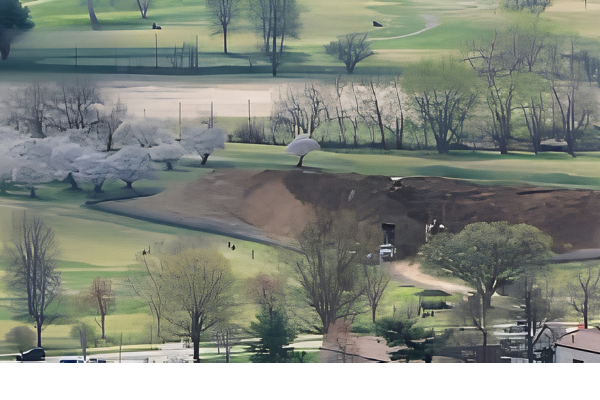
Debris from the demolition of the White House East Wing that was dumped at a nearby public golf course has reportedly tested positive for lead, chromium, and other toxic metals, according to an interim report commissioned by the National Park Service. The material was transported to the historic East Potomac Golf Links in Washington, D.C., where the Trump administration is planning major renovations to transform the public facility into what officials described as a “world-class” golf destination.
The report, prepared by Jacobs Engineering Group, found traces of hazardous substances including PCBs, pesticides, petroleum byproducts, arsenic, and other contaminants in soil samples collected at the golf course. More than 30,000 cubic yards of excavated debris from the East Wing demolition had reportedly been transferred to the site by April after dumping operations began in October 2025.
The East Wing was demolished as part of President Donald Trump’s plan to build a 90,000-square-foot ballroom on White House grounds. Initially promoted as a privately funded $400 million project tied to national security upgrades, the ballroom’s estimated cost has reportedly increased significantly due to added security requirements.
The Department of the Interior defended the disposal process, stating that the soil was tested multiple times and met all legal safety standards. Officials maintained that all required procedures were followed before the debris was relocated to the golf course.
Environmental advocates and preservation groups, however, have raised concerns about public health risks and environmental oversight. The nonprofit DC Preservation League filed lawsuits challenging both the dumping of debris and the administration’s broader redevelopment plans for the golf course and surrounding public land. The group argued that the contamination could pose hazards to golfers, nearby residents, and the environment.
The controversy has become part of a larger debate over Trump’s efforts to reshape public spaces in Washington, D.C. In addition to the golf course redevelopment, critics have objected to proposals involving the Kennedy Center, the National Mall, and other landmark areas in the nation’s capital.
A federal judge recently ordered the government to provide notice before removing additional trees at the golf course while litigation continues. Preservationists and local residents have argued that the historic East Potomac Golf Links, which opened in 1921 and has long been known as an affordable public course, could lose much of its public character under the planned redesign.