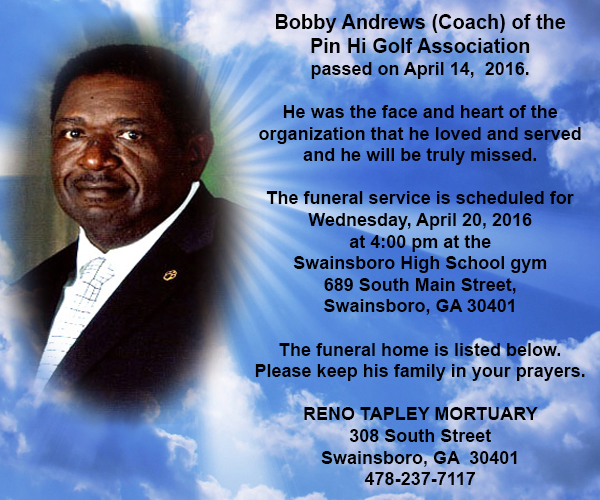
In 2003, Coach Bobby Andrews was a recipient of the Outstanding Leaders in Golf Award that was presented to him by the African American Golfer’s Digest on September 23 at the Upper Richmond Community Center, Columbia, S.C.

In 2003, Coach Bobby Andrews was a recipient of the Outstanding Leaders in Golf Award that was presented to him by the African American Golfer’s Digest on September 23 at the Upper Richmond Community Center, Columbia, S.C.
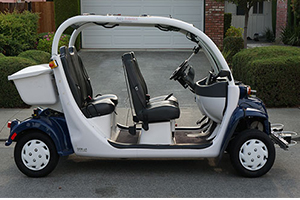
Talk about a long drive.
Amid the pageantry of the Masters Tournament in Augusta, Georgia, Velodyne LiDAR today announced its collaboration with SMART, the Singapore-MIT Alliance for Research and Technology, on an experimental deployment of fully autonomous golf carts, guided by the company’s 3D real-time VLP-16 LiDAR Puck, the most cost-effective LiDAR sensor on the market.
As reported in MIT News late last year, SMART conducted “an experiment over six days at a large public garden in Singapore, in which self-driving golf carts ferried 500 tourists around winding paths trafficked by pedestrians, bicyclists, and the occasional monitor lizard.” SMART is a partnership between MIT and the National Research Foundation of Singapore.
For the experiment, researchers from MIT and Singaporean universities enlisted two modified Yamaha electric golf carts, each equipped with a webcam and Velodyne’s 16-channel real-time 3D VLP-16 LiDAR Puck, which replaced earlier 2D sensors. The carts transported passengers along the paths while autonomously navigating and watching for such obstacles as pedestrians and animals. The golf carts jockeyed for position along with everyone, and everything, else on the paths.
Carts cruised at a top speed of about 15 miles per hour, relying on a “dynamic virtual bumper” – in effect, a cylinder surrounding the vehicle’s planned trajectory – rather than GPS. The cylinder’s width and length changed in response to the vehicle’s velocity. When an obstacle entered the cylinder, the vehicle’s onboard computer modified the cylinder to exclude it — altering the trajectory, reducing the velocity, or both.
According to MIT News, the experiment also tested an online booking system through which visitors could schedule pickups and drop-offs at any of 10 stations around the garden, routing and redeploying the vehicles automatically to accommodate requests. When surveyed about the experience, 98 percent of passengers said they would like to ride the carts again and 95 percent would return to the garden if the carts became a permanent attraction.
“We [took] a minimalist solution to the self-driving-car problem,” Daniela Rus, a professor in MIT’s Department of Electrical Engineering and Computer Science, told MIT News. “The vehicles are instrumented, but they are not as heavily instrumented as the DARPA vehicles were [or] as, say, the Google car. We believe that if you have a simple suite of strategically placed sensors and augment that with reliable algorithms, you will get robust results that require less computation and have less of a chance to get confused by ‘fusing sensors,’ or situations where one sensor says one thing and another sensor says something different.”
“SMART’s experiment points the way toward future passenger shuttle-type operations, especially those that don’t require build-out of an extensive infrastructure,” said Wei Weng, Velodyne Asia Sales Director. “Velodyne LiDAR has become the de facto standard for autonomous vehicles and we’re delighted to have assisted SMART in its rigorous test, in an environment that was as ‘real world’ as it gets. Whether on an actual golf course, a park with pathways or the open road, LiDAR technology is consistently reliable, whatever the lighting or weather conditions.”
About Velodyne LiDAR
Founded in 1983 and based in California’s Silicon Valley, Velodyne LiDAR Inc. is a technology company known worldwide for its real-time LiDAR (light detection and ranging) sensors. The company evolved after founder/inventor David Hall competed in the 2004-05 DARPA Grand Challenge using stereovision technology. Based on his experience during this challenge, Hall recognized the limitations of stereovision and developed the HDL-64 Solid-State Hybrid LiDAR sensor. Velodyne subsequently released its compact, lightweight HDL-32E sensor, available for many applications including UAVs, and the new VLP-16 LiDAR Puck, a 16-channel real-time LiDAR sensor that is both substantially smaller and dramatically less expensive than previous generation sensors. Market research firm Frost & Sullivan has honored the company and the VLP-16 with its 2015 North American Automotive ADAS (Advanced Driver Assistance System) Sensors Product Leadership Award. Since 2007, Velodyne LiDAR has emerged as the leading developer, manufacturer and supplier of real-time LiDAR sensor technology used in a variety of commercial applications including autonomous vehicles, vehicle safety systems, 3D mobile mapping, 3D aerial mapping and security. For more information, visit http://www.velodynelidar.com.

Get Golf Ready continues to introduce thousands of adults to the game of golf each year with a record number of 107,485 men and women participating in programs in 2015 (a nine percent increase from the 98,919 participants in 2014). In addition, Get Golf Ready had success in retaining golfers with approximately nine out of 10 students continuing to play golf in their first year. More than 465,000 students have participated in Get Golf Ready since its inception in 2009.
Now in its eighth year, Get Golf Ready is an industry-supported, fun and affordable program designed to introduce golf to the millions of adults who have never played or have minimal golf experience. Get Golf Ready offers a series of lessons in a group setting that focus on basic instruction on chipping, putting and full swing techniques, as well as information on how to navigate the clubhouse and golf course, etiquette and rules of golf.
 “PGA Professionals nationwide are offering Get Golf Ready to their communities as a fun, affordable and accessible entryway to golf,” said PGA President Derek Sprague. “Get Golf Ready has a proven track record of welcoming newcomers to the game and helping participants feel comfortable on the course.”
Furthermore, the program continues to diversify the game and introduce newcomers who may not ordinarily seek traditional lessons from a facility. Last year, 66 percent of participants were women; 24 percent were people of multi-cultural backgrounds; and 39 percent had never picked up a club.
Golf’s health, social and professional benefits help draw beginners to the game, which can be enjoyed by people of all ages and skill levels. It’s a healthy activity that provides for quality, uninterrupted time outdoors – health and fitness experts advocate taking 10,000 steps per day, which is the equivalent of 18 holes or five miles walked. Golf also provides an outlet to strengthen relationships with friends, family, or colleagues. In a recent survey from Sports & Leisure Research Group, both men and women executives ranked golf as the most effective networking activity with clients and co-workers, and nearly 60 percent of business men and women have closed deals at the golf course.
Additional statistics on Get Golf Ready’s impact on the industry include:
Get Golf Ready continues to prove successful in retaining golfers: in 2015, 87 percent (or approximately nine out of 10 Get Golf Ready participants) continued playing in their first year, an increase from 81 percent in 2014.
Consumers can learn more and find a local participating facility at GetGolfReady.com.


Two New Sites will Host the 2016 LPGA Leadership Academies
After a successful pilot program in 2015, AXA Financial Group is sponsoring two LPGA Leadership Academies!
Forty, special young women, ages 14 – 18 will be selected to attend this two-day academy with LPGA’s finest teaching professionals!
The LPGA Leadership Academy will provide the tools for teenage girls to discover how they envision their unique leadership potential through team-building activities, communication development, and, of course, golf!
Participants will enjoy a free, two-day academy in an idyllic environment while developing their golf skills with the help of some of the nation’s best LPGA Teaching Professionals and female executives. Utilizing golf as the medium, key life-lessons will be addressed throughout the Academy, which will ultimately unlock each girl’s true potential.
How do you get selected?
First step is to complete an application for the site that you would like to attend. Once all of the applications are reviewed, forty girls will be selected to attend the academy. You must be between the ages of 14 -18 with golf experience and equipment to be considered. For more details about the academies at each location, see below:
July 12 – 13, 2016
Riverwalk Golf Club
1150 Fashion Valley Rd
San Diego, CA 92108
Click here to apply for this location
August 22 – 23, 2016
Glen Arbor
234 Bedford Center Road
Bedford Hills, NY 10507
Click Here to Apply for this location
The application deadline is Friday, May 6, 2016.

In August 1996, Tiger Woods turned professional and set about changing the game of golf forever.
Over the intervening 20 years, he’s set records on the course and off it with his prodigious talent and immense marketability.
And it’s over the greens and fairways of Augusta National that the now 40-year-old Woods has cemented his legacy.
Of his 14 major triumphs, four have come at the iconic course.
Although he won’t be gracing this year’s tournament — the second time in three years Woods has missed the Masters — his presence is always felt when the year’s first major comes around.
As he prepares to enter his third decade as a pro athlete, CNN reporters recall the times they met one of the history’s most fascinating sportsmen.
“I have long been a sports fan and followed Woods’ amateur career. When CNN asked me if I would like to meet Tiger and interview him, I jumped at the opportunity. I believed he would likely become the best golfer to ever play the game.
“People were very excited to meet him. There was a buzz on the boardwalk in Atlantic City, New Jersey where this all took place. People knew he was a young man who was likely to make history.
“Woods was polite, thoughtful, and considerate. I remember thinking to myself that I hoped he would always stay that way because I was so certain he would be immensely successful and so many people who become rich and famous don’t keep the values they had when it all began.
Read more by By Tom McGowan, Gary Tuchman, Don Riddell and Shane O’Donoghue, on CNN.com

 “For the sixth year in a row, I am honored to declare April as National Black Golf Month. The 30-days in April offer a tremendous benefit to golfers who wish to get out on the course and play the game, and an opportunity for those who are curious about playing, to learn more” said Debert Cook, CMP, publisher of the 13-year-old, national magazine. The featured event for National Black Golf Month is the New Orleans Jazz and Golf Masters Tournament & Achievement Awards. “We hope that golfers, and non-golfers, will flock to New Orleans for this exciting program that we have been promoting for several months, honoring some of the best in golf and jazz.”
Celebration the sixth year of National Black Golf month, the African American Golfer’s Digest is openly inviting golf clubs, organizations, and industry and community leaders nationwide to join in championing the effort that is geared to raising awareness of the game among African Americans.The designated month has received support from several U.S. mayors, who have declared their patronage by proclaiming a “National Black Golf Month” and “National Black Golf Month Day” in their respective cities including: Mayor Michael R. Bloomberg (New York, NY); Mayor Mayor Kasim Reed (Atlanta, GA); Mayor William A. Bell, Sr. (Birmingham, AL); Mayor Jim Suttle (Omaha, NE) and Mayor Buddy Dyer (Orlando, FL). Others are also expected to join the campaign throughout the month. A resolution was also introduced into the Louisiana Legislature by Senator Karen Carter Peterson.
We are reaching people this April at the core of Black communities—in inner-city schools, churches and at public courses, referring them to our National Calendar of Golf Events and our list of African American Golf Trainers, all to help Black Americans to become involvement in the game,” says Cook.

According to the National Golf Foundation (NGF) research report, Minority Golf Participation in the U.S, 2015 edition, Twenty years after Tiger Woods stepped before a microphone in Milwaukee on Aug. 28, 1996, and with the words “Hello, World,” touched off the most meaningful golf industry growth since Arnold Palmer and President Eisenhower jump-started it 40 years earlier, there are reasons to be confident about the stability of the game.
While the latest NGF participation numbers show a slight dip in 2015 to 24.1 million (over the age of 6 who played at least once) from 24.7 million the two previous years, numbers remained strong in several crucial areas: among committed golfers, beginning golfers and in the number of people interested in taking up the game. While the total drop in golfers from 2014 to 2015 was within the national study’s statistical margin of error, the results do suggest that a slow leak in overall participation persists. However, NGF analysis continues to show that attrition is confined mainly to those who never really got into the game.
“It has always been the mission of our publication to grow and expose the game to as many Black people in America as we possible could. Golf has so many benefits socially, health-wise and it is a wonderful game that can be played for a lifetime,” said Ms. Cook. “Golf is one of the fastest growing sports among our demographic, and by declaring April as National Black Golf Month, it is our desire to see citizens, young and old, in all of our communities, at all income levels become involved in this game that is filled with influential leaders.”
Previously, Cook has mentioned the fact that Black people are becoming genuinely concerned about what they eat, how much they work out, their overall health, and many are now seeking to engage in activities where they feel accepted and comfortable. “National Black Golf Month is what this is all about.”
“Many people have been surprised to learn that this monthly designation exists; they had no idea there are free golf programs for their youth, scholarships for their students, and more….this is all great news to spread” says Cook.

 The minivan that introduced the “family people mover” vehicle concept raises the bar to a new level with the newly designed 2017 Chrysler Pacifica. Manufactured on a brand new platform that offers more technology and functions, including the first Hybrid in the minivan class.
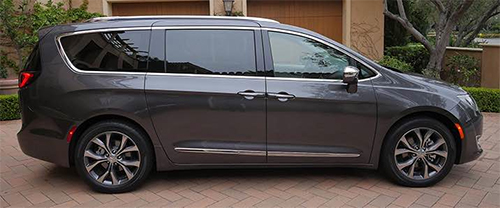
The original minivan was introduced by Chrysler more than 30 years ago, grew out of the need to “move family, people and stuff”, according to Chrysler engineers, “we wanted to build the best people mover possible.

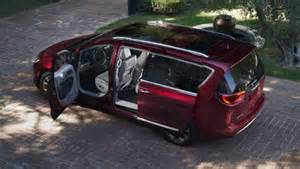
I recently got my first drive in the 2017 Pacifica on location at the Pelican Beach Golf Resort in Newport Beach, California. It may well cross over from soccer moms to soccer dads with its car-like handling and stylist design. The new Pacifica attracted lots of attention and it felt more like driving an SUV than the traditional minivan.
More than 17-million Pacifica’s have sold since its inception and the time is right to build a newly upgraded minivan, from the ground up, and on an all-new platform that significantly improves handling, vibration that looks and rides like a luxury vehicle.
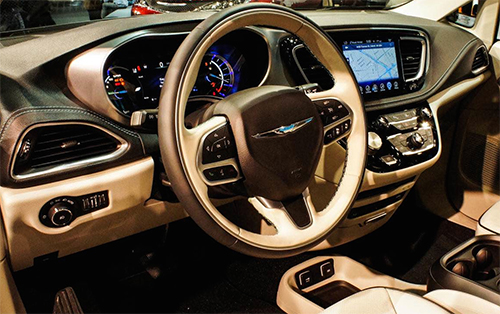
The new Pacifica has more than 100 safety and security features that come standard, including a 360-degree Surround View camera, ParkSense Parallel/Perpendicular Park Assist, Adaptive Cruise Control with Stop and Hold and Collision avoidance systems.
 Two engine choices are offered with the all-new 2017 Chrysler Pacifica, including the next-generation of the Pentastar V-6 gasoline engine that generates 287 horsepower and averages 28 mpg on the highway. It is paired with a segment-exclusive TorqueFlite nine-speed automatic transmission.
The first Hybrid minivan in the industry, the Pacifica Hybrid includes an electric 16-kWh lithium-ion (Li-ion) battery that delivers an average 30 miles on electric power and has an MPGe rating of 80 miles per gallon, based on U.S. Environmental Protection Agency standards.
An innovative pivotal technology sits behind the all-new Chrysler Pacifica Hybrid, which consist of an electrically variable transmission (EVT). The device features two electric motors, both capable of driving the vehicle’s wheels.
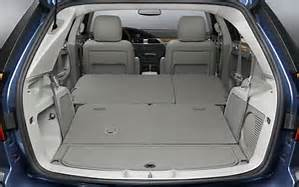
The 2017 Chrysler Pacifica has a traditional seven-seat capacity (an eight-seat seating configuration is a $495 option), dual-sliding side doors, and the popular Stow-N-Go folding seats. Fortunately, the second row seems more comfortable than the overly low and tilted setup of the previous model. Of course, Chrysler claims the Pacifica has the largest interior volume in the segment and is capable of hauling 4×8-foot sheets of plywood.
It will take several articles to review the many features in the new Pacifica’s array of comfort and convenience technologies, including a Stow ‘n Vac integrated vacuum, tri-pane panoramic sunroof, handsfree sliding doors and lift-gate.
The Pacifica has a standard seven-seat capacity, which can be stowed into the floor or easily removed to create space or reduce weight. For another $495, an optional eight seats are available.
The base Pacifica LX starts at $28,595 and the top-of-the-line Limited tops out at $42,595. The Pacifica Touring L starts at $34,495 and offers creative and colorful leather interior and seating, power lift-gate, and some leading edge active safety features.
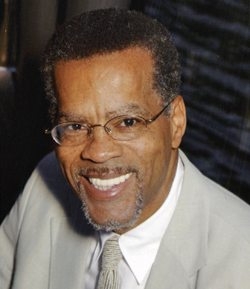 Randi Payton is Founder at Decisive Media, Washington D.C. Metro Area.
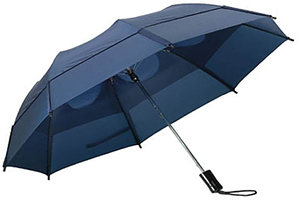
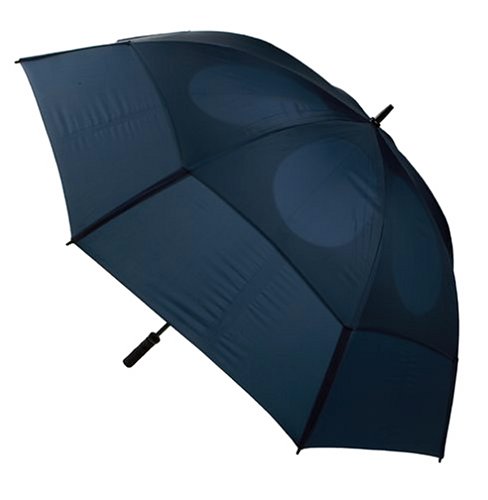
 You’ll be protected and dry when you pop open The GustBuster® umbrella. Known for it’s attributes o being: “UNflippable, UNflappable, UNleakable™”, GustBuster umbrella is in a category of its own when it comes to superior quality and manufacturing.
There are lots of other umbrella companies who tote their ability to overcome strong wind and rain, but the GustBuster has a long and proven record of success. Like they say, GustBuster is often “Copied, but Never Duplicated!”
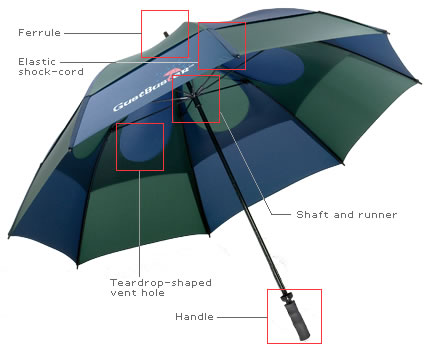
GustBuster® is the only umbrellas that has the exclusive Raindrop-Shaped Wind Release Vents™–No other shape works as well to withstand seasonal elements. The award winning double canopy design is unmatched and developed through time and investment in research . The GustBuster is certified to withstand a wind tunnel of up to 55+ mph by the College of Aeronautics, making this umbrella the finest available.
Produced with190 thread count nylon canopy — this umbrella is water, bleed and fade proof. The oatented elastic shock-cord us an origina, with a wide double velcro closure system that keeps the GustBuster neatly and securely wrapped.
Innoventions Enterprises, Ltd. has created the GustBuster® family of umbrellas to fulfill a single purpose: to produce the finest wind-proof umbrellas possible, and sell them at a price that offers the best value.
Over the past 10 years, we have continued to improve on all aspects of our umbrella design and introduced new products into the GustBuster umbrella family. Best of all, the GustBuster umbrellas are backed by a limited lifetime guarantee.
MSRP: $60.00
Recently, a diversity and inclusion report was done for the golf industry, reporting female and minority participation rates in recreational and competitive play, plus workforce diversity. Diverse participation rates in recreational play, and those competing competitively hasn’t changed much since 2003, when the first report of this kind was completed. It might surprise you, though, that diversity in the workforce seems to be regressing, and the recent survey revealed that 90% of those employed within the golf industry were males, and 88% of them were white. The sample size for this survey was over 60,000 people.
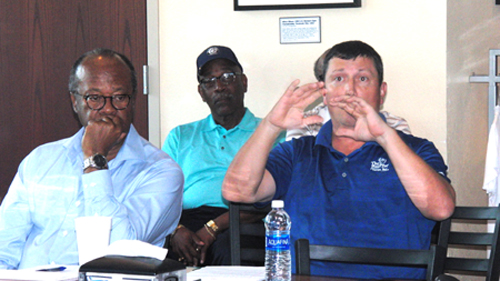
Photo: (l-r) Earnie Ellison, Charles Sifford, Jr, and Ian Baxter, Executive Director for The First Tee of Tampa Bay.
In the report, eight recommendations were made to help increase gender and ethnic diversity and inclusion in golf. Identifying, engaging, and listening to those already involved in grass roots efforts was embedded in three of the recommendations. I serve as a board member for two groups that I consider grass roots organizations determined to make a difference, and who work diligently to help bring awareness and greater diversity to golf. These two organizations are the Advocates Pro Tour and the National Black Golf Hall of Fame.
You probably know by now that Christian Heavens recently won the first 2016 Advocates Pro Tour event at Rogers Park GC, in Tampa, FL. He was 13 under par for two rounds, and finished one shot ahead of Kevin Hall to win the title, and the $7500 first place monies. What you might not know is that a diversity roundtable discussion preceded tournament play, and approximately 50 people attended to talk about the lack of diversity and inclusion in golf, and what should be done to increase participation. Two of the primary objectives for hosting the diversity roundtable discussion were to collect the thoughts of those passionate about the topic, particularly the ones working at the grass roots levels, and to share their thoughts with the leaders in the golf industry. I had the honor to facilitate the Tampa session, and both objectives were accomplished.
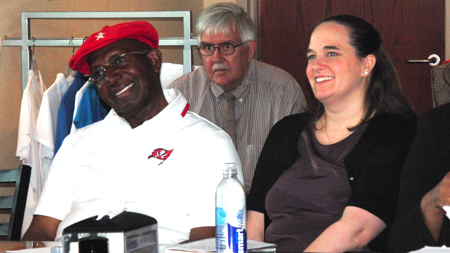 Photo: (l-r) Tampa teaching pro Billy Parker, Brad Janss, The First Tee of Tampa Bay board member, and Deanna Molina with the USGA
Some traveled hundreds of miles to take part in the Tampa diversity discussions, including a representative from the USGA, World Golf Foundation, fellow Advocates Pro Tour board members, and several from the Golf 20/20 Diversity Task Force. Earnie Ellison was there, as was Scott Walker, Charles Sifford, Jr., and author Ramona Harriet.
There were reps from The First Tee of Tampa Bay, National Black Golf Hall of Fame, Pope & Associates (trainers for diversity and inclusion), the University of Maryland Eastern Shore Diversi-TEE initiative, and upstart programs like Women of Color, and Golf-My Future-My Game. Several players from the Advocates Pro Tour participated, too, as did some of their parents. One very special participant was Lee Elder, the first black to play in the Masters, at Augusta National CC…way back in 1975.
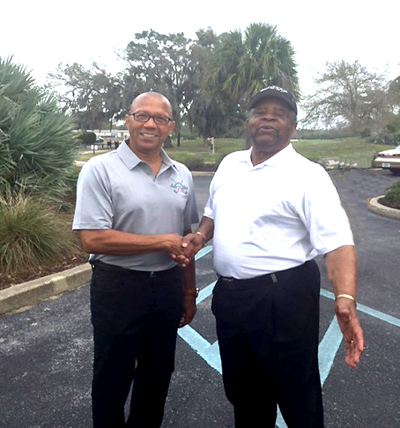 When asked if he thought we’d still be having conversations about diversity in golf, some 40 years after his historic breakthrough at the Masters, Mr. Elder pondered a moment, and then said: “No, I didn’t think we’d still be talking about this now. I thought we’d have long moved beyond a lack of diversity in the sport.”
Photo: (l-r) Michael Cooper and Lee Elder
These conversations will continue, with the next diversity roundtable discussion scheduled for the weekend of May 20-22, 2016, in Atlanta. That’s the weekend for the second 2016 Advocates Pro Tour event, and the 30th anniversary for the National Black Golf Hall of Fame dinner and induction ceremony. Your participation is requested. Please check the respective websites for details, or contact me directly if you have any questions.
Send Michael a Comment!
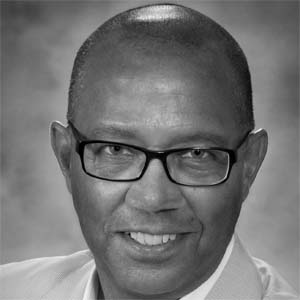 ABOUT MICHAEL COOPER, PH.D. Dr. Michael W. Cooper is the former Director of Diversity for the World Golf Foundation/The First Tee and past Assistant Dean/Campus Director for Springfield College-Tampa Bay campus. Contact him at [email protected]

Tiger Woods announced on his website Friday night that he will sit out next week’s Masters, marking the second time he has skipped the year’s first major golf championship in the last three years.
Once again, the four-time Masters champion attributed his decision to health concerns.
“After assessing the present condition of my back, and consulting with my medical team, I’ve decided it’s prudent to miss this year’s Masters,” Woods said on his website.
“I’ve been hitting balls and training daily, but I’m not physically ready. I’ve said all along that this time I need to be cautious and do what’s best for my long-term health and career. Unfortunately, playing Augusta next week wouldn’t be the right decision. I’m absolutely making progress, and I’m really happy with how far I’ve come, but I still have no timetable to return to competitive golf.”
Woods, who turned 40 in December, has been out of competition since tying for 10th place at the Wyndham Championship in August. He complained about pain in his hip that week, but a subsequent trip to see his surgeon, Dr. Charles Rich, in Utah determined the pain stemmed from the same spot in his back where he had a microdiscectomy performed in March 2014. Woods underwent a second microdiscectomy in September, then endured a second back surgery a month later.
Read more by Nick Eilerson in the Washington Post
 On Aug. 28, 1963, more than 200,000 people took to the streets of Washington, D.C. The March on Washington aimed to highlight the inequalities African-Americans faced socially and politically in the U.S. It was where the famous speech “I Have a Dream” was delivered by Martin Luther King Jr. from the steps of the Lincoln Memorial.
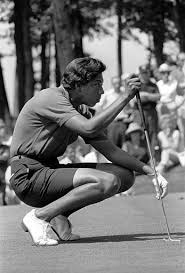
That same year, tennis legend Althea Gibson became the first black golfer in the Ladies Professional Golf Association (LPGA). There is little documentation of Gibson’s time in golf, even though she played 171 events between 1963 and 1977. Having never won an event, her time in golf seemed lackluster compared to her tennis career.
The brilliance of her golf career was not based on her results, though. During a time when racial tensions were boiling and when golf courses routinely discriminated against people of color, Gibson made a statement that people’s prejudices wouldn’t stop her from pursuing her athletic endeavors.
“If I made it, it’s half because I was game enough to take a lot of punishment along the way and half because there were a lot of people who cared enough to help me,” she wrote in her 1958 memoir “I Always Wanted to Be Somebody.”
Breaking new barriers
Gibson was born on Aug. 25, 1927, in Silver, South Carolina. Three years later, she was sent to New York City to live with her aunt Sally. It was on the Harlem River Courts, at 12 years old, that Gibson picked up tennis, finding a natural talent for the sport.
Her love and dedication to tennis paid off when she won the French Open in 1956, becoming the first African-American to win a Grand Slam title. In all, she won 11 Grand Slams before retiring in 1958 and was arguably the most famous female athlete during her time.
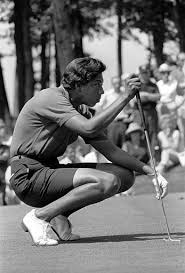
Althea Gibson is shown in New York City on Dec. 12, 1963, after she signed a contract as a golf pro with Dunlop.
Despite her success, tennis was still an amateur sport, so she survived off the generosity of loved ones. In an effort to make money, she recorded several records as a singer and toured with the Harlem Globetrotters, playing tennis before games.
So the question remains: Where did golf come in? While attending Florida A&M in the early 1950s, Gibson took a golf class, and what she learned during that time stayed with her, according to Rex Miller, who directed “Althea,” a PBS American Masters documentary film about the trailblazing athlete.

At 36, Gibson changed course and found herself making history again after earning status to play on the LPGA Tour.
“The siren song of golf was barely audible to me when I retired from amateur tennis,” Gibson wrote in “So Much to Live For,” her 1968 autobiography. “But it was never completely out of hearing, and soon it was to grow so loud that I would not be able to resist its seductiveness.”
While Gibson had support from the LPGA Tour and the players, her time in tennis prepared her for the hardships of playing golf professionally.
There were select clubs, like the Beaumont Country Club in Texas, that allowed Gibson to play but would not allow her into the clubhouse, denying her access to bathrooms and forcing her to change in her car.
Early on in Gibson’s golf career, she formed a friendship with fellow tour player Marlene Hagge. While Gibson was checking into a hotel, after calling and confirming her reservation, the hotel said that it neither had her reservation nor any space. Hagge walked into the lobby as Gibson tried to sort out her accommodations and overheard what was taking place. Hagge proceeded to sign in, asked for two keys and turned to Gibson and said, “You’re rooming with me.”
However, having spent years playing tennis, a sport predominantly for the white and wealthy, this did not phase her.
“She was hardened to things,” said Renee Powell, a close friend of Gibson’s and the second African-American to qualify for the LPGA in 1967. “Because of the fact that she was in tennis and broke color barriers in tennis, when she went to golf, things didn’t bother her. She was focused on playing the game. She wasn’t trying to open doors, she was just trying to play [the] game and make a living.”
Renee Powell said Althea Gibson opened the door for her when it came to playing in places that had never welcomed a black person before.
While Gibson and Powell received death threats and faced slurs from the galleries, particularly in the South, the LPGA supported them.
Read more by Anya Alvarez at ESPN.com