
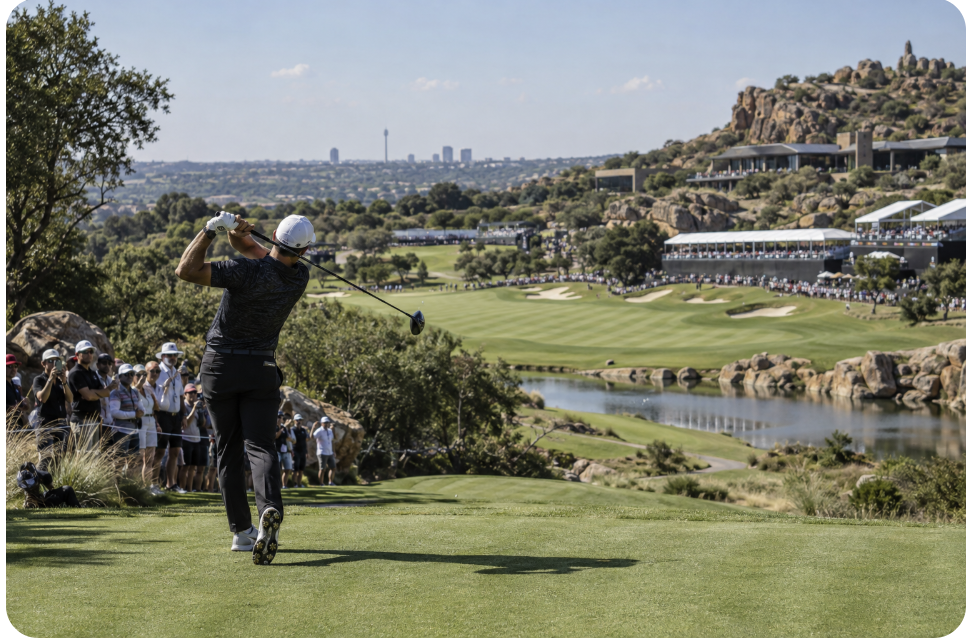
When LIV Golf held its first African event at Steyn City north of Johannesburg in March, Polymarket was already running a live prediction market on whether the league would announce its shutdown before the year was out.
The crowd had it priced at a coin-toss even then. By July 28th, they had pushed it to 75% probability of closure. Prediction markets and traditional sports books both had live positions on LIV’s survival for much of the season. The best sports betting sites in South Africa reflected it through outright tournament markets and team matchups. The market read the situation more accurately than the league’s own communications did.
More than 20,000 people came through the Steyn City gates over three days, Southern Guards GC played a home event for the first time in front of Bryson DeChambeau, Jon Rahm and the rest of the field, and none of it changed the underlying arithmetic. On 8th September, LIV filed for Chapter 11 bankruptcy with between five hundred million and one billion dollars in liabilities.
LIV Spent Five Billion Dollars and Filed for Bankruptcy Before the Season Was Over
PIF pulled its backing in April, and the Polymarket closure probability moved immediately. The fund had deployed approximately five billion dollars into LIV since 2022, and the confirmation that the investment required over the longer term was no longer consistent with its priorities was read by prediction market traders for what it was.
Over $72,000 traded on the shutdown question across the season, with the closure probability sitting between 60% and 80% for most of the period between April and August. When LIV chief executive Scott O’Neil posted on LinkedIn in early August announcing a new lead investor and the LIV 2.0 model, the market swung to 16% closure probability within days. That is the prediction market working as it should: new information, repriced probability.
The problem was that the information turned out to be selectively optimistic. The Louisiana event had already been canceled. The forty million dollar team championship in Michigan followed. The season ended in Indianapolis at the end of August, and on 8 September the bankruptcy filing confirmed what the 75% probability had been pricing all along.
The bankruptcy filing listed Jon Rahm as the largest unsecured creditor at $7.5 million owed, with agency IMG down $3.2 million and players offered settlements at a substantial discount on their guaranteed contracts. The SportsPro account of the bankruptcy filing covers the full creditor list, the BC Partners relationship and what LIV 2.0 is intended to look like under Chapter 11 restructuring. For anyone who had held a position on the survival market all year, the outcome confirmed what the crowd had been pricing since April: the model built on sovereign wealth fund guarantees was not sustainable without the sovereign wealth fund.
Southern Guards GC Exists in a League That Is Restructuring Around a Ten-Event Calendar
LIV’s CEO Scott O’Neil confirmed in his bankruptcy letter that BC Partners Credit, a London-based private equity firm, is the planned new backer and that players will take majority equity stakes in their franchises under LIV 2.0. The proposed model runs ten events in 2027, five international and five in the United States, timed around the major championships. South Africa has been identified internally as a market whose event performed well, which keeps Steyn City in the conversation for a slimmed-down calendar rather than out of it entirely.
What the Steyn City event represented for this publication’s readership was a different question. Harold Varner III, one of the few Black Americans who signed with LIV, was part of the Majesticks GC roster that competed in Johannesburg, playing at the largest stadium ever to host a professional golf event on African soil.
The audience that followed LIV partly because of Varner’s presence had a stake in what happened to the tour’s finances, and the Chapter 11 filing laid out what PIF’s exit and the bankruptcy process means for players across the league. Guaranteed contracts are being renegotiated at a discount. The players who bet on LIV with their careers are now being asked to bet on it again, this time with equity stakes in a restructured model rather than guaranteed money from a sovereign wealth fund.
The Honest Position Is That One Good Week Does Not Guarantee a Future
A ten-event LIV means fewer guaranteed paydays for Southern Guards’ four members, all of whom are established professionals who built their careers before LIV existed and will find their footing regardless of how the restructure goes. Oosthuizen, Schwartzel, Burmester and Grace are not financially dependent on LIV 2.0 in the way that younger players signed under the original PIF-funded contracts might be. What they are is the recognisable faces that made the Steyn City event worth watching for a South African crowd, and that matters for whether a future event draws comparable numbers.
The prediction market will reopen if a 2027 schedule is confirmed, and it will open at a very different baseline than April 2026 did. A tour in Chapter 11 restructuring, backed by private equity rather than a sovereign wealth fund, with a ten-event calendar and players as majority equity holders, is a different proposition to price than the one that drew 20,000 people to Steyn City. Any book that priced LIV outright markets in March will price a 2027 Johannesburg event at odds that reflect what this season revealed about the tour’s financial structure. Johannesburg earned its place as a proof of concept. Whether it earns a place on the restructured calendar is being decided in a New Jersey court, and this time the prediction markets will be watching from the first announcement.