
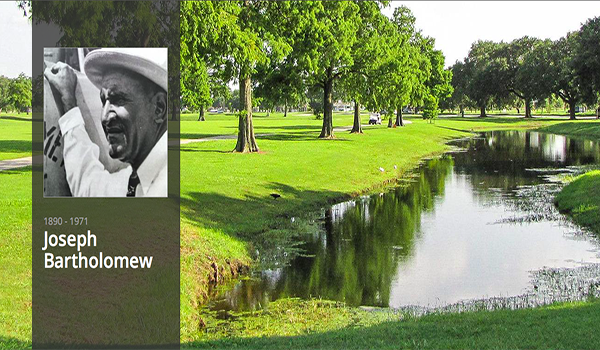
Joseph Manuel Bartholomew was the first African American golf course architect in the United States, but was barred by segregation from playing the very courses he designed.
Born on August 1, 1885 in New Orleans, Bartholomew left school after the eighth grade and began caddying at Audubon Golf Club in the Crescent City where he met golf professional Freddie McLeod.
McLeod could hardly have overlooked the young Bartholomew, who was barely able to carry a single bag, let alone the customary double. Bartholomew, however, prided himself in finding errant shots. “It distracts a golfer to lose the ball,” he said, claiming that he “never lost a golf ball in a year.”
Impressed with Bartholomew’s enthusiasm, McLeod offered him a job fixing golf clubs, and Bartholomew recalled the conversation.
“He told me, ‘I can’t give you $3 [the daily pay for caddies at Audubon]—just 50 cents.’ I figured I could learn more from Mr. McLeod than I [could] as a caddy. So I took it.”
www.BusinessGlitz.com. “Joseph Bartholomew, Golf Course Architect.” Undated, pp. 1-5.
Freddie McLeod was born in Scotland and served as golf professional at Rockford Country Club in Illinois in the early 1900s. McLeod stood just five feet four inches tall and weighed only about one hundred pounds, earning the nickname “The Wasp.”
As a world-class golfer, McLeod won the United States Open in 1908, the North and South Open in 1909 and 1920, and the PGA Senior Championship in 1938. In the 1960s and 1970s, he served as an honorary starter at the Masters. On May 8, 1976, shortly after returning from Augusta, Georgia to his home in Washington, DC, McLeod suffered a heart attack and died at age 94.
Sports Illustrated. “Fractured Fairways,” www.Vault.Si.com, April 24, 2006.
Seaton, Douglas. “North Berwick Fact File: Famous North Berwick Golfers: Fore Please, Freddie
McLeod Now Driving.” www.NorthBerwick.org.uk, 2001.
In a decade at Audubon, the young Bartholomew learned to repair the fragile wooden-shafted clubs of that era and to maintain a golf course, rising to the position of head greenskeeper. By observing the golf swings of good players, Bartholomew taught himself to play the game and was permitted by McLeod to give lessons to Audubon members—as many as twelve sessions a day for $2 each.
www.AfricanAmericanGolfersDigest.com. “Joseph M. Bartholomew: First African American Golf Course Architect and Designer.” 2017, p. 1.
Mieczkowski, Colin. “Black History Month: Joseph Bartholomew: A Golf Course Design Legend.” www.ThePunchBowlGolf.com, March 2, 2020, pp. 1-6.
Johnson, Roy S. “Overlooked No More: Joseph Bartholomew, Golf Course Architect.” www.TheNewYorkTimes.com, February 7, 2020, pp. 1-3.
“Efforts Under Way to Celebrate the Legacy of Joe Bartholomew.” New Orleans, Louisiana, The Louisiana Weekly, October 6, 2014, pp. 1-2.
One Audubon member was so impressed with Bartholomew that he persuaded fellow members to send Joseph to Long Island to train with celebrated golf course architect Seth Raynor (1874–1926). Raynor had studied civil engineering at Princeton University, but left college to begin working with Charles Blair (C.B.) MacDonald, famed architect of many classic American courses.
Audubon members planned to build a new golf course and were happy to help Bartholomew, hoping that when he returned, he might design their new course. In a 1949 interview in Fortune Magazine, Bartholomew remembered: “They gave me a whole bunch of money and asked me to go and find the best course in the world and bring it back.”
www.creolegend.org. “Negro Businessmen of New Orleans.” Fortune Magazine, November 1949, September 23, 2015.
Walsh, Niall Patrick. “Once Racially Discriminated from His Own Architecture, Joseph Bartholomew is Overlooked No More.” www.ArchDaily.com, February 14, 2020, pp. 1-6.
www.MetairieGolfClub.org. “Club History.” November 27, 2021.
In 1922, Bartholomew completed his training with Raynor and returned to New Orleans, bringing with him the design of a golf course whose holes replicated famous ones in Scotland and America. Audubon members were pleased with Bartholomew’s layout and commissioned him to build the course on one hundred thirty acres near Metairie Ridge (pronounced Met-a-ree) on the outskirts of New Orleans. Bartholomew’s construction crew worked at night to shield his layout from prying eyes. Some Audubon members, though, wanted to inspect the course during its construction, so one morning, Bartholomew loaded them into wagons and took them for a tour of the unfinished layout. They were delighted with the design.
Walsh, Niall Patrick. “Once Racially Discriminated from His Own Architecture, Joseph Bartholomew is Overlooked No More.” www.ArchDaily.com, February 14, 2020, pp. 1-6.
www.wikipedia.org. “Joseph Bartholomew, Golf Course Designer.” September 23, 2021, pp. 1-2.
www.AfricanAmericanGolfers’Digest.com. “Joseph M. Bartholomew: First African American Golf Course Architect and Designer.” 2017, p. 1.
www.MetairieCC.org. “Club History.” November 27, 2021.
The course opened in 1925 as Metairie Country Club, and the club’s website, as well as publications on Seth Raynor, say that Raynor, not Bartholomew, actually designed the course. A few sources do attribute Metairie’s design to Bartholomew, although a 1999 article in the New Orleans Times-Picayune says that Raynor designed the course, while Bartholomew supervised its construction. The newspaper’s assertion may be correct because Raynor traveled extensively and could not personally manage the construction of every course he designed. In fact, during the three years of Metairie’s construction, Raynor designed or renovated at least six courses: Riddell’s Bay Golf Course in Bermuda (1922), Chicago Golf Club (1923), Brookville Country Club in New York (1924), The Country Club of Charleston, South Carolina (1925), Fox Chapel Golf Club in Pittsburgh (1925), and Rock Spring Club in Summit, New Jersey (1925). On completion of Metairie Golf Club, Bartholomew was named the club’s teaching professional, but because of segregation was barred from playing the self-same course he was instrumental in building.
Tatum, Doug. “Joseph Bartholomew: 175th Anniversary Story.” Times-Picayune, New Orleans, Louisiana, January 1, 2012.
www.SethRaynorSociety.US. “Seth Raynor Courses.” November 30, 2021.
www.SethRaynor.SquareSpace.com. “Courses Designed or Renovated by Seth Raynor.” November 30, 2021.
www.BusinessGlitz.com. “Joseph Bartholomew, Golf Course Architect.” Undated, pp. 1-5.
Johnson, Roy S. “Joseph Bartholomew Overlooked: Black History Month.” www.TheNewYorkTimes.com, February 5, 2020, pp. 1-3.
www.AfricanAmericanGolfersDigest.com. “Joe Bartholomew, Golfer, and Golf Course Designer.” June 30, 2017, p. 1.
Johnson, Roy S. “Overlooked No More: Joseph Bartholomew, Golf Course Architect.” www.TheNewYorkTimes.com. February 7, 2020, pp. 1-3.
After his work at Metairie Golf Club, Bartholomew started his own construction company, leaseing heavy equipment to fellow contractors. Bartholomew received construction contracts for offices, factories, and houses, including installing the exterior of Charity Hospital and building parts of the Johns-Manville plant and Higgins Shipyard in New Orleans. Bartholomew also built an ice cream plant. Bartholomew then partnered with a man he had caddied for to form a land development company that prepared lots for homes. Bartholomew and his partner bought hundreds of acres of land and improved the property using Bartholomew’s equipment.
www.BusinessGlitz.com. “Joseph Bartholomew, Golf Course Architect.” Undated, pp. 1-5.
Johnson, Roy S. “Overlooked No More: Joseph Bartholomew, Golf Course Architect.” www.The New York Times.com, February 5, 2020, pp. 1-3.
In the mid-1950s, Bartholomew returned to golf by designing and constructing Pontchartrain Park Golf Course in New Orleans with William Wiedorn, a local landscape architect. The course opened on April 29, 1956 as Louisiana’s first municipal golf course accessible to African Americans and the only course in New Orleans on which Bartholomew was permitted to play. Bartholomew became the first professional at Pontchartrain Park Golf Course, having donated the land for the course and stipulating that the course be open to the public.
Johnson, Roy S. “Overlooked No More: Joseph Bartholomew, Golf Course Architect.” www.TheNewYorkTimes.com, February 7, 2020, pp. 1-3.
Pontchartrain Park Golf Course is an 18-hole, par 72 course of between 5,314 and 6,823 yards with a clubhouse, putting green, and double-ended practice range. The course lies in a New Orleans sub-division with the same name, built between 1955 and 1961 as one of the first residential communities for African Americans in the South.
www.PlayNolaGolf.com. “Joseph Batholomew Golf Course.” June 3, 2026.
Pontchartrain Park was designed to resemble Gentilly Woods, a nearby community for white residents. The Gentilly Woods Neighborhood Association, displeased with the plans for Pontchartrain Park, submitted a petition to the city with one thousand signatures to stop the development, but the appeal failed. In 1979, Ernest Morial, the first Black mayor of New Orleans, recognized the importance of Pontchartrain Park Golf Course and its creator by renaming the facility the “Joseph M. Bartholomew Municipal Golf Course.” At the ceremony, residents of Pontchartrain Park unveiled a bust of Joseph Bartholomew and an artist’s rendering of a statue to be created in his honor.
Preservation Resource Center of New Orleans. “The History and Politics Behind Pontchartrain Park.” www.prcno.org, December 4, 2021.
“Efforts Under Way to Celebrate the Legacy of Joe Bartholomew, Sr.” New Orleans, Louisiana, The Louisiana Weekly, October 6, 2014.
Thomas, Rob. “Heritage Awards: The Not-So Big Easy: Builder Excellence Awards: Duininck Golf and Joseph M. Bartholomew, Sr. Municipal Golf Course.” www.GolfCourseIndustry.com, September 12, 2011, pp. 1-7.
Tatum, Doug. January 1, 2012. “Joseph Bartholomew: 175th Anniversary Story”. New Orleans, Louisiana, Times-Picayune, January 1, 2012.
On August 29, 2005, Hurricane Katrina inundated Pontchartrain Park and its golf course with more than fifteen feet of water, claiming some eighty lives in that community and approximately eighteen hundred lives throughout New Orleans. The Bartholomew golf course was so damaged that it was closed for six years. However, the City of New Orleans commissioned a renovation of the course, appreciating its importance to the city and its African American citizens.
“Without the course there is no neighborhood, and without the neighborhood there is no course,” said Ann McDonald of the New Orleans Parks and Parkways Department. African Americans in New Orleans greatly respected Joseph Bartholomew and his contributions to golf and local organizations.
“I learned about [Bartholomew] from some of the guys that lived around here and played with him,” said Glen Dexter of the association called Friends of the Bartholomew Golf Course. “Some of the older guys that are no longer around knew how important he was in terms of making sure that golf stayed alive in the city.”
Barks, Joe. “New Orleans’ Joe Bartholomew GC Featured as Part of Martin Luther King Tributes” www.ClubandResortBusiness.com, January 2, 2018.
“Joe Bartholomew Stands Among the Most Enterprising Men Our City Has Ever Produced.” www.WGNONewsDesk.com, January 1, 2018.
www.TheAdvocate.com. “A Community and Course Come Roaring Back: Joseph M. Bartholomew Municipal Golf Course,” March 7, 2019.
Five years after Hurricane Katrina, the Duininck Golf Company of Minnesota and Texas began restoring the Bartholomew course. The company sought to preserve as much of the original routing as possible and reopened the course in the spring of 2011, although some green complexes, bunkers, and tees, destroyed by flooding, had to be replaced. Harris Duininck, senior partner of Duininck Golf, said that his firm had not experienced conditions “this tough as long as I have been around the business, and that is over 50 years.” In November 2011, the Joseph M. Bartholomew Municipal Golf Course re-opened. For its restoration work on the course, the Duininck Golf Company received an award from the golf course industry, and in 2020, Pontchartrain Park was placed on the National Register of Historic Places.
Thomas, Rob. “Heritage Awards: The Not-So Big Easy: Builder Excellence Awards: Duininck Golf and Joseph M. Bartholomew, Sr. Municipal Golf Course.” www.GolfCourseIndustry.com, September 12, 2011, pp. 1-7.
www.DuininckGolf.com. “Capabilities and Portfolio.” 2016.
Tatum, Doug. “Joseph Bartholomew: 175th Anniversary Story.” New Orleans, Louisiana, Times-Picayune, January 1, 2012.
Barks, Joe. “New Orleans’ Joe Bartholomew GC Featured as Part of Martin Luther King Tributes,” www.ClubandResortBusiness.com, January 2, 2018.
After building Pontchartrain Park Golf Course, Bartholomew and William Wiedorn built two other municipal courses in New Orleans called City Park No. 1 and City Park No. 2. Bartholomew also designed and constructed courses in other Louisiana cities, including Covington, Hammond, Abita Springs, Algiers, and Baton Rouge. Bartholomew built a seven-hole course called Crescent City Golf Club on property he owned in Harahan, Louisiana, a town on the Mississippi River west of New Orleans. All his courses were open to the public.
Mieczkowski, Colin. “Black History Month: Joseph Bartholomew: A Golf Course Design Legend.” www.ThePunchBowlGolf.com, March 2, 2020, pp. 1-6.
www.AfricanAmericanGolfersDigest.com. “Joseph M. Bartholomew: First African American Golf Course Architect and Designer.” 2017, p. 1.
“Efforts Under Way to Celebrate the Legacy of Joe Bartholomew, Sr. The Louisiana Weekly, October 6, 2014, pp. 1-2.
www.tclf.org. “The Cultural Landscape Foundation,” Undated, p. 1.
Johnson, Roy S. “Overlooked No More: Joseph Bartholomew, Golf Course Architect”. www.The New York Times.com, February 7, 2017. pp. 1-3.
Walsh, Niall Patrick. “Once Racially Discriminated from His Own Architecture, Joseph Bartholomew is Overlooked No More.” www.ArchDaily.com, February 14, 2020, pp. 1-6.
Joseph Bartholomew was an important donor to Dillard University in New Orleans, a private, historically Black institution, and Xavier University of Louisiana, a private, historically Black Catholic college. In 1972, he was posthumously named the first African American to the Greater New Orleans Sports Hall of Fame.
In segregated Louisiana, Joseph Bartholomew rose from caddying and repairing golf clubs at Audubon Golf Club to positions as greenskeeper, golf professional, and golf course architect. Bartholomew was not only an avid golfer, but a respected teacher of the game. He designed and built the cherished Pontchartrain Park Golf Course, the first New Orleans course open to African Americans and plausibly the first course available to Black golfers in the South.
Bartholomew and his wife, the former Ruth Segue, had a son, Joseph, Jr., and twin daughters, Leontine and Ruth.
Joseph Bartholomew surmounted ancient prejudices to broaden the accessibility of the game he loved and died on October 12, 1971 at age eighty-six.
In both golf and life, Joseph Manuel Bartholomew walked his own fairways.
ABOUT DR DENNIS P. McLINAY
Dr. Dennis P. McIlnay is Professor Emeritus of Management at the Shields School of Business at Saint Francis University in Pennsylvania and the author of two books on charitable foundations and three books on aspects of the history of Pennsylvania. He also writes about golf. He and his wife, Kathy, live in the town of Hollidaysburg, Pennsylvania.
Sources in Alphabetical Order
Barks, Joe. “New Orleans’ Joe Bartholomew GC Featured as Part of Martin Luther King Tributes” www.ClubandResortBusiness.com, January 2, 2018.
“Efforts Under Way to Celebrate the Legacy of Joe Bartholomew, Sr.” New Orleans, Louisiana, The Louisiana Weekly, October 6, 2014.
“Joe Bartholomew Stands Among the Most Enterprising Men Our City Has Ever Produced.” www.WGNONewsDesk.com, January 1, 2018.
Johnson, Roy S. “Joseph Bartholomew Overlooked: Black History Month.” www.TheNewYorkTimes.com, February 5, 2020, pp. 1-3.
Mieczkowski, Colin. “Black History Month: Joseph Bartholomew: A Golf Course Design Legend.” www.ThePunchBowlGolf.com, March 2, 2020, pp. 1-6.
Preservation Resource Center of New Orleans. “The History and Politics Behind Pontchartrain Park.” www.prcno.org, December 4, 2021.
Seaton, Douglas. “North Berwick Fact File: Famous North Berwick Golfers: Fore Please, Freddie McLeod Now Driving.” www.NorthBerwick.org.uk, 2001.
Sports Illustrated. “Fractured Fairways,” www.Vault.Si.com, April 24, 2006.
Tatum, Doug. “Joseph Bartholomew: 175th Anniversary Story.” New Orleans, Louisiana, Times-Picayune, January 1, 2012.
Thomas, Rob. “Heritage Awards: The Not-So Big Easy: Builder Excellence Awards: Duininck Golf and Joseph M. Bartholomew, Sr. Municipal Golf Course.” www.GolfCourseIndustry.com, September 12, 2011, pp. 1-7.
Walsh, Niall Patrick. “Once Racially Discriminated from His Own Architecture, Joseph Bartholomew is Overlooked No More.” www.ArchDaily.com, February 14, 2020, pp. 1-6.
www.AfricanAmericanGolfers’Digest.com. “Joseph M. Bartholomew: First African American Golf Course Architect and Designer.” 2017, p. 1.
www.ArchDaily.com, February 14, 2020, pp. 1-6.
www.BusinessGlitz.com. “Joseph Bartholomew, Golf Course Architect.” Undated, pp. 1-5.
www.creolegend.org. “Negro Businessmen of New Orleans.” Fortune Magazine, November 1949, September 23, 2015.
www.DuininckGolf.com. “Capabilities and Portfolio.” 2016.
www.MetairieGolfClub.org. “Club History.” November 27, 2021.
www.PlayNolaGolf.com. “Joseph Batholomew Golf Course.” June 3, 2026.
www.SethRaynor.SquareSpace.com. “Courses Designed or Renovated by Seth Raynor.” November 30, 2021.
www.SethRaynorSociety.US. “Seth Raynor Courses.” November 30, 2021.
www.tclf.org. “The Cultural Landscape Foundation,” Undated, p. 1.
www.TheAdvocate.com. “A Community and Course Come Roaring Back: Joseph M. Bartholomew Municipal Golf Course,” March 7, 2019.
www.wikipedia.org. “Joseph Bartholomew, Golf Course Designer.” September 23, 2021, pp. 1-2.

